



Introduction
Generative AI has created a new discovery and consideration layer. A buyer can ask an AI system to explain a category, compare brands, shortlist products, evaluate risks, or recommend the best option for a specific use case. The answer may mention a brand, link to a product page, cite an independent source, or direct the user to a merchant. That influence happens before the user reaches the brand’s website—and sometimes without a visit at all.
This is why AI visibility cannot be the final goal. Mention Rate, Share of AI Voice, Recommendation Position, and Citation Probability show whether the brand is present in the answer layer. They do not show whether the exposure produced an engaged visit, a qualified lead, an order, or revenue. Leadership ultimately needs to know where AI contributes to customer acquisition, which prompts and products create commercial value, and whether investment in GEO is improving business performance rather than only generating favorable screenshots.
The measurement chain appears simple: AI recommendation → AI website visit → customer action → conversion → revenue. In practice, every arrow contains uncertainty. The user may see the recommendation but not click. A browser or app may not pass a recognizable referrer. The user may copy a brand name, search it later, switch devices, ask a colleague to evaluate the product, or convert after several other channels. For B2B companies, weeks or months can separate discovery from closed revenue. For e-commerce brands, a customer may visit several times or purchase through a marketplace.
AI attribution solves this problem by combining observable event data with clearly labeled inference. It does not turn an incomplete journey into perfect certainty. Instead, it defines which touchpoints can be directly measured, which can be linked as assistance, and which require aggregate evidence. This article explains the framework and the role of GeoEye Pixel within it. For the answer-layer metrics that precede attribution, see GeoEye’s guide, “How to Track Your Brand’s Visibility in ChatGPT, Perplexity, and Gemini.”
1. Why AI Attribution Matters
AI search changes the economics of discovery. Traditional organic reporting often starts when a page receives an impression or a website receives a visit. AI influence can start earlier, when the system defines the category, excludes unsuitable options, presents a shortlist, or explains why one brand fits the user’s constraints. If measurement begins only after the click, the brand cannot distinguish an ordinary referral from a visit shaped by a recommendation. If no click occurs, the influence may disappear entirely from channel reporting.
Attribution gives GEO a commercial operating model. Visibility data identifies where the brand appears. Citation data shows which sources support the answer. Pixel and analytics data show what users do after reaching the site. CRM and commerce data show whether those actions become qualified opportunities or purchases. Revenue data allows teams to compare outcomes by AI platform, landing page, product, market, and time. The combination helps answer not only “Are we visible?” but “Where does visibility create demand?”
This matters for resource allocation. A prompt cluster can produce high mention rates but weak traffic because the answers satisfy informational intent without a visit. Another can generate fewer mentions yet deliver product-page sessions with strong conversion. A third can influence enterprise pipeline through non-click research that later appears as branded search or direct traffic. Without attribution, a team may overinvest in easy visibility and underinvest in the prompts, content, citations, and product experiences that drive revenue.
Attribution also creates accountability across functions. Content teams can see which resources assist AI referrals. Product marketing can identify which use cases convert. Communications can connect third-party citations with downstream demand. Growth teams can improve landing pages and CTAs. Sales can record AI-assisted discovery in the CRM. Analytics teams can establish confidence tiers and reconcile Pixel events with the system of record. GEO becomes a measurable growth program rather than an isolated content experiment.
| Business principle: AI visibility is a leading indicator. Revenue impact is the business outcome. A mature GEO program measures the relationship between them without pretending that every exposure is directly observable. |
|---|
2. Limitations of Traditional Analytics
Traditional analytics is essential, but it was not designed to observe the full answer-layer journey. It can record a website session after a click, attribute a source when referral information is available, capture events, and connect transactions to a session or user identifier. It generally cannot see what the user asked inside an external AI system, which brands appeared in the answer, whether the brand was recommended, or whether the user read the answer and returned later through another channel.
Referrer loss and direct traffic
A recognizable AI referrer is the cleanest signal of direct traffic from an AI interface, but it is not always passed. Apps, privacy controls, redirects, copied links, new tabs, and browser behavior can remove or obscure the source. Google Analytics describes “(direct) / (none)” as traffic without clear referral information. Some of that traffic is genuinely direct; some is dark traffic whose earlier source cannot be determined. Treating all direct traffic as AI would inflate contribution, while treating none of it as AI would understate influence.
Non-click and delayed journeys
A user can see an AI recommendation, remember the brand, and search for it later. A procurement lead can share the recommendation with a team. A consumer can compare products in AI, then purchase from a marketplace or physical store. A B2B prospect can convert after several meetings. Website analytics can observe later touchpoints, but it cannot prove that the earlier answer caused them unless a durable, consented identifier or explicit survey evidence connects the journey.
Session-based channel bias
Last-click reporting favors the channel that immediately precedes conversion. If AI creates awareness and branded search closes the visit, the search channel receives the credit. First-touch reporting can produce the opposite distortion when a later AI interaction materially changes the decision. Data-driven and multi-touch models can distribute credit, but they still depend on observable touchpoints. An unrecorded AI exposure cannot be recovered through a more sophisticated formula.
Platform and prompt opacity
A referral domain may identify the AI platform, but it rarely reveals the exact prompt, answer, brand position, or citation that produced the click. The precise relationship is available only when a trackable link or identifier carries that context, or when GeoEye can connect the landing behavior with separately captured prompt evidence and a controlled campaign design. Otherwise, attribution should remain at the platform, landing-page, product, or cohort level.
| Measurement question | Traditional analytics can show | What AI attribution adds |
|---|---|---|
| Was there a website visit? | Session, landing page, source/medium when available | Whether the referrer matches a known AI surface and the AI context available |
| What did the visitor do? | Page views, engagement, events, conversions | A standardized AI journey from product view to CTA, lead, or purchase |
| Which answer influenced the visit? | Usually not visible | Prompt or citation linkage only when a reliable identifier or controlled mapping exists |
| Did AI influence later conversion? | Only observable touchpoints in the selected model | Direct, assisted, and inferred contribution reported separately |
| What should the team optimize? | Channel and landing-page performance | Prompt, platform, citation, product, funnel, and revenue relationship |
3. What Is AI Attribution?
The word “evidence-based” is important. Attribution is not a fact automatically produced by a dashboard; it is a model applied to observed data. The model defines which touchpoints qualify, how long they remain relevant, how identity is resolved, which conversion events matter, and how credit is distributed. A defensible AI attribution program makes those assumptions visible.
Direct AI attribution
Direct attribution applies when an identifiable AI referral or tracked AI link leads to a website session and the defined conversion occurs within the accepted session or attribution window. For e-commerce, the outcome may be a purchase with revenue and currency. For B2B, it may be a qualified lead, booked meeting, or opportunity value. Direct attribution is the highest-confidence category because the observable chain is intact, although it still describes association within a defined rule rather than philosophical proof of causation.
Assisted AI attribution
Assisted attribution applies when AI is a recorded touchpoint in a longer customer journey but another channel completes the conversion. A visitor may arrive from Perplexity, return through branded search, and purchase. A prospect may visit from ChatGPT, download a guide, later join a webinar, and become an opportunity. The AI touchpoint receives assistance credit under a documented model. It should not receive the same label as direct last-touch revenue.
Inferred AI contribution
Inferred contribution applies when user-level linkage is unavailable but aggregate evidence indicates likely influence. Examples include rising AI visibility followed by increased branded demand in the same prompt cluster, survey respondents naming ChatGPT as a discovery source, or a controlled geographic test showing greater conversion lift where AI visibility improved. Inference is valuable, but its confidence depends on design quality and alternative explanations. It should be reported as modeled or directional rather than exact revenue.
The unit of attribution
An attribution record should connect as much of the following chain as the available evidence permits: platform → prompt or prompt cluster → answer exposure → cited or recommended source → landing page → product → session → event → conversion → revenue. Not every implementation will resolve every field. The system should preserve nulls rather than invent detail. This principle protects decision quality and allows the model to improve as better links, consented identifiers, CRM data, or experiments become available.
AI attribution therefore complements rather than replaces GA4, commerce analytics, and CRM reporting. Those systems remain critical sources of truth for sessions, transactions, leads, and revenue. GeoEye adds the AI-specific classification and the answer-layer context needed to interpret those outcomes. The result is a bridge between GEO performance and business performance.
4. AI Revenue Measurement Framework
The AI Revenue Measurement Framework follows two connected funnels. The first is the decision funnel: AI recommendation → website visit → customer action → conversion → revenue. The second is the technical observation funnel shown below: AI mention → AI click → website session → conversion event → revenue attribution. The difference is important. The customer can move through the decision funnel even when the measurement system cannot observe every step. Attribution quality depends on how much of the technical funnel remains connected.
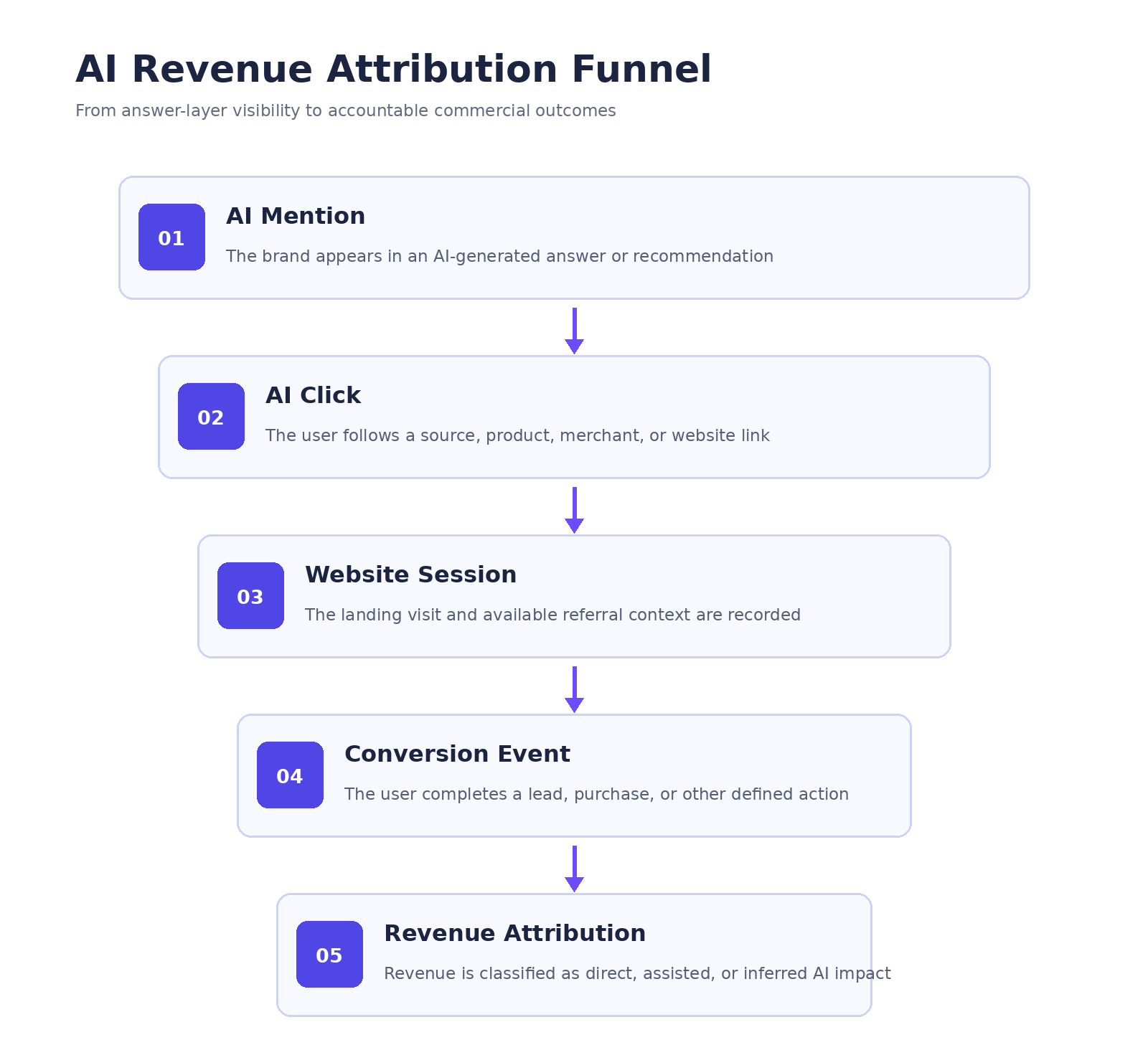
Figure 1: AI Revenue Attribution Funnel
Stage 1: AI recommendation or mention
GeoEye visibility monitoring records whether the brand appears for eligible prompts, its recommendation role, position, citations, competitors, platform, market, and date. Pixel does not run inside an external AI answer and cannot observe a person merely reading it. This stage is measured through controlled AI visibility testing. It establishes the exposure opportunity and the denominator for later analysis.
Stage 2: AI website visit
When the user follows a website, product, citation, or merchant link, the website can record the landing session and the referral context the browser provides. Known AI referral domains can be classified into an AI channel. Campaign parameters or tracked links can preserve more context when the brand controls the URL, but brands should not assume that every external AI interface retains custom parameters. Referral data must be captured at landing because later navigation can overwrite or lose it.
Stage 3: Customer action
A session becomes commercially meaningful through behavior. Relevant events include product-page views, documentation views, pricing-page visits, video engagement, CTA clicks, form starts, downloads, chat initiations, add-to-cart actions, and checkout starts. The event taxonomy should match the business model. A B2B brand may prioritize qualified demo requests; a retailer may prioritize product views and add-to-cart behavior. Events should have stable names, timestamps, page or product identifiers, and consented session context.
Stage 4: Conversion
The brand defines which events qualify as conversions. A newsletter signup may be useful but should not be treated as equivalent to a sales-qualified lead. For commerce, purchases should include transaction ID, product or order value, currency, and deduplication logic. For B2B, the website conversion can be joined with CRM stages such as qualified lead, opportunity, and closed-won revenue. The conversion definition must be agreed before reporting so teams do not change the goal after seeing the data.
Stage 5: Revenue attribution
Revenue is assigned according to a documented model and confidence tier. Direct revenue follows an identifiable AI referral or tracked AI click under the selected rule. Assisted revenue includes a recorded AI touchpoint in a multi-touch journey. Inferred contribution uses aggregate analysis where direct linkage is unavailable. Report the observation window, identity method, deduplication rules, refund handling, marketplace limitations, and currency treatment. A transparent model is more useful than a precise-looking number built on hidden assumptions.
| Metric / event | What it records | Minimum context | Business question |
|---|---|---|---|
| AI referral session | Landing session from a recognized AI source | Source/referrer, landing URL, session ID, timestamp | Which AI platforms send identifiable visits? |
| Product page visit | View of a tracked product or service page | Product/page ID, session ID, timestamp | Which offerings attract AI-referred demand? |
| CTA click | Click on a primary action | CTA ID, page, product, session | Which messages move AI visitors forward? |
| Lead | Submitted or qualified inquiry | Lead event, session/user linkage, CRM status where available | Do AI visits produce qualified demand? |
| Purchase | Completed transaction | Transaction ID, product/order, value, currency | Which AI journeys produce orders? |
| Revenue contribution | Direct, assisted, or inferred value | Attribution model, window, confidence tier | How much revenue is associated with AI? |
Core formulas and reporting logic
AI referral conversion rate equals AI-referred conversions divided by eligible AI referral sessions. AI revenue per session equals directly attributed AI revenue divided by AI referral sessions. Product engagement rate can be defined as AI sessions with a tracked product view or meaningful action divided by eligible AI sessions. For B2B, AI lead-to-opportunity rate and AI pipeline value may be more informative than immediate revenue. Every formula needs a stable denominator, event definition, time window, and exclusion rule.
Do not divide all revenue by AI mentions and call the result revenue per mention unless the visibility sample and audience exposure are genuinely comparable. Controlled prompt tests measure the brand’s presence, not the number of people who saw the answer. The connection between visibility and revenue should be analyzed as a trend or experiment, with sample size and uncertainty, rather than as a direct impression-based media metric.
5. How GeoEye Pixel Helps Brands Measure AI Impact
GeoEye Pixel is a lightweight event-measurement layer designed to connect identifiable AI-originated website behavior with GEO reporting. Visibility monitoring observes the answer layer; the Pixel begins when a visitor reaches the brand’s website. It records the available landing context and defined on-site events, then makes those events analyzable by AI source, landing page, product, market, and conversion outcome. The Pixel does not claim visibility into private conversations or non-click exposure.
Capture AI referral sessions
On the landing page, GeoEye Pixel can classify sessions from recognized AI referral sources when the browser supplies usable referral information. It preserves the source, landing URL, timestamp, session identifier, and configured campaign parameters. This enables a dedicated AI traffic view rather than leaving all identifiable visits inside a general referral bucket. Where the referrer is missing, the Pixel does not automatically relabel direct traffic as AI.
Map product-page and CTA behavior
The Pixel can record page and product identifiers for visits to priority URLs, then capture configured actions such as pricing views, CTA clicks, form starts, downloads, chat openings, add-to-cart events, and checkout initiation. Teams can compare which products receive AI-referred visits, which landing pages retain attention, and where users abandon the funnel. This separates an answer-layer problem from an on-site conversion problem.
Record leads and purchases
For lead generation, the implementation can fire a lead event after a successful form submission and pass non-sensitive event context such as form type, page, product, and qualification status when configured. It should not collect raw form contents or personal data that are unnecessary for measurement. For commerce, the purchase event can include transaction ID, revenue, currency, and product data, with deduplication to prevent the same order from being counted twice. CRM or commerce systems remain the authoritative source for final lead status, refunds, and recognized revenue.
Connect outcomes with visibility context
GeoEye can analyze Pixel outcomes alongside platform-level visibility, prompt clusters, cited sources, recommendation position, and tracked products. Exact prompt-to-session linkage is used only when a reliable identifier or controlled landing path preserves that relationship. Otherwise, reporting remains at the source, product, landing-page, market, or cohort level. This distinction avoids false precision while still showing whether improved AI visibility is associated with better commercial performance.
Support GA4 and CRM reconciliation
GeoEye Pixel is not intended to replace the brand’s analytics or CRM. GA4 can provide traffic acquisition and website behavior; a commerce platform records orders; a CRM records lead quality, pipeline, and closed revenue. Read-only connections and event reconciliation can compare these systems with GeoEye’s AI-specific classification. Differences should be investigated rather than forced to match, because systems can use different sessionization, attribution windows, time zones, consent states, and revenue definitions.
Privacy, consent, and data minimization
Pixel implementation must follow applicable privacy laws, consent requirements, platform policies, and the brand’s privacy notice. Collect only the event fields necessary for the defined measurement purpose. Avoid sending sensitive form content. Respect consent state before firing non-essential measurement where required. Define retention, access controls, deletion procedures, and processor responsibilities. Server-side or first-party implementations can improve governance and data control, but they do not remove legal or consent obligations.
References
A Practical Attribution Operating Model
Implementation begins with a measurement contract shared by marketing, analytics, product, sales, and legal teams. Define the AI sources in scope, the business outcomes, the event dictionary, the direct and assisted windows, the identity and consent rules, the source of truth for revenue, and the confidence labels used in reporting. Without this contract, teams will debate numbers after launch because they are using different definitions.
Step 1: Establish the AI visibility baseline
Track representative customer prompts across relevant AI platforms and record brand mentions, recommendation position, citations, competitors, market, and date. Group prompts by product, intent, and buying stage. This creates the answer-layer baseline against which traffic and revenue changes can be interpreted. GeoEye’s article “How AI Search Engines Decide Which Brands to Cite” explains why source evidence should be captured alongside the mention.
Step 2: Implement and validate the event taxonomy
Install the Pixel under an approved consent design, configure AI source classification, and map product pages, CTAs, lead events, purchase events, revenue, and currency. Test duplicate events, cross-domain journeys, redirects, single-page applications, checkout flows, and form success states. Compare event counts with GA4, commerce, and CRM systems using controlled test sessions before relying on the dashboard.
Step 3: Select attribution rules and confidence tiers
Define direct attribution, assisted attribution, and inferred contribution in writing. Set windows appropriate to the buying cycle. A consumer purchase may use a shorter window than enterprise software. Decide how repeat visits, multiple AI sources, refunds, subscription revenue, and marketplace purchases are handled. Report confidence alongside value so leadership can distinguish observed revenue from modeled influence.
| Tier | Evidence | Revenue label | Recommended use |
|---|---|---|---|
| Direct | Identifiable AI source or tracked AI link connected to conversion | Direct AI revenue | Operational reporting and conversion optimization |
| Assisted | Recorded AI touchpoint appears in a multi-touch converting journey | AI-assisted revenue or pipeline | Journey analysis and channel collaboration |
| Inferred | Aggregate visibility, survey, branded-demand, or experimental evidence | Modeled AI contribution | Strategy and directional investment decisions |
| Unattributed | Insufficient evidence to connect AI with the outcome | Unattributed revenue | Preserve uncertainty; do not force assignment |
Step 4: Build a layered dashboard
Report the chain in layers: AI visibility, identifiable AI referral sessions, product engagement, CTA actions, conversions, direct revenue, assisted value, and inferred contribution. Segment by platform, prompt cluster where supportable, product, market, landing page, and period. Keep volume and rate metrics together. Ten purchases from 100 sessions tell a different story from ten purchases from 10,000 sessions.
Step 5: Run optimization loops
Use the data to diagnose the constraint. Low visibility requires entity, content, or citation work. Strong visibility with few visits may reflect low-click informational intent or weak source placement. Healthy visits with poor engagement point to landing-page relevance. CTA clicks without conversion may indicate form, offer, pricing, or checkout friction. Revenue concentration in a small prompt or product cluster can guide future content and distribution. The objective is to move the entire funnel, not maximize one metric in isolation.
A Realistic Business Example
Consider a fictional B2B compliance platform, ClearLedger. GeoEye tracking shows that the brand’s mention rate increases for prompts about vendor risk management, and an implementation guide begins receiving citations. The website then sees identifiable referrals from AI platforms to the guide and a related product page. GeoEye Pixel records engaged sessions, pricing CTA clicks, and demo submissions. The CRM later classifies several submissions as qualified opportunities.
The company does not label all resulting pipeline as direct AI revenue. One opportunity converted during the original AI-referred journey and qualifies under the direct rule. Others returned through branded search or sales outreach and are reported as AI-assisted pipeline. A quarterly survey also shows more prospects naming AI tools as a discovery source, but those responses cannot be matched to every session; they support an inferred contribution analysis. The dashboard presents all three categories separately.
The result changes strategy. Informational prompts generated visibility but few product actions. Comparison and implementation prompts produced fewer mentions but stronger conversion. The team invests in evidence and landing experiences for those high-intent clusters, strengthens CRM source capture, and tests a controlled product landing page. AI attribution turns a broad GEO initiative into a prioritized revenue program while preserving the uncertainty inherent in the channel.
Frequently Asked Questions
What is AI attribution?
AI attribution is the process of connecting AI-generated discovery, mentions, recommendations, citations, and referral visits with customer actions and business outcomes. It combines answer-layer visibility data with website events, analytics, CRM or commerce records, and, where needed, aggregate evidence such as surveys or controlled tests. A responsible model separates direct attribution from assisted and inferred contribution. Direct attribution has an observable AI referral or tracked link connected to conversion. Assisted attribution records AI as one touchpoint in a longer journey. Inferred contribution uses aggregate evidence when user-level linkage is unavailable. The purpose is not to claim perfect causality; it is to make the evidence, assumptions, attribution window, and uncertainty explicit.
Can a Pixel track an AI mention inside ChatGPT or Gemini?
No website Pixel can run inside a private conversation on an external AI platform. AI mentions and recommendation position must be measured through controlled visibility testing or platform-provided data. The Pixel begins when a visitor reaches the brand’s website. It can record the landing session, available referral context, page or product activity, CTA clicks, lead events, purchases, and revenue fields that the brand configures. Exact prompt-to-session linkage is possible only when a reliable identifier or controlled URL preserves that context. Otherwise, the analysis should stay at the AI platform, landing-page, product, market, or cohort level.
How does GeoEye identify AI referral traffic?
GeoEye Pixel can inspect the referral context available when a session lands on the website and classify recognized AI referral sources into an AI channel. It can also retain configured campaign parameters and landing-page context. This works only when the browser or app passes usable information. Copied links, privacy controls, redirects, new tabs, and some application flows may remove the referrer, causing the visit to appear direct or unknown. GeoEye should not automatically classify all direct traffic as AI. Brands can improve analysis by combining referral data with visibility trends, self-reported discovery, CRM notes, branded-search behavior, and controlled landing-page tests.
What events should brands track for AI revenue measurement?
At minimum, track the landing session, source or referrer when available, landing page, product or service page views, primary CTA clicks, lead submissions or purchases, transaction or opportunity identifiers, revenue value, currency, and timestamps. B2B companies may add qualified lead, meeting, opportunity, and closed-won stages. E-commerce brands may add product view, add to cart, checkout start, purchase, refund, and order value. Every event should have a stable definition and deduplication rule. Collect only necessary data, avoid sensitive form contents, respect consent requirements, and reconcile final revenue with the CRM or commerce system of record.
What is the difference between direct and assisted AI revenue?
Direct AI revenue is associated with an identifiable AI referral or tracked AI link that leads to conversion under the brand’s documented session or attribution-window rule. Assisted AI revenue occurs when AI is a recorded touchpoint but another channel completes the conversion. For example, a user may first visit from Perplexity and purchase later through branded search. Both signals are useful, but they should not be merged into one number. Direct attribution has higher observational confidence; assisted attribution describes AI’s role in a multi-touch journey. A third category—inferred contribution—covers aggregate evidence that suggests influence without user-level linkage.
Can AI attribution prove that an AI recommendation caused a sale?
Usually not in the strict causal sense. Attribution assigns credit according to observed touchpoints and declared rules. Even a direct referral followed by a purchase shows a strong association, but other influences may have contributed. Causal evidence becomes stronger through controlled experiments, holdouts, geographic tests, randomized exposure where feasible, or well-designed quasi-experiments. Many brands will rely on triangulation: direct referrals, assisted journeys, surveys, branded-demand changes, CRM notes, and time-based comparisons. The report should state the confidence level and alternative explanations rather than present modeled contribution as certain causation.
Key Takeaways
AI visibility is a leading indicator; the commercial goal is measurable customer action, conversion, and revenue.
AI attribution connects answer-layer exposure with website sessions, product behavior, leads, purchases, and revenue using explicit evidence and rules.
Traditional analytics captures identifiable website activity but cannot observe every AI prompt, recommendation, non-click exposure, or cross-device journey.
GeoEye Pixel begins at the website visit; it does not run inside external AI conversations or directly observe people who read an answer without clicking.
Core Pixel events include AI referral sessions, product-page visits, CTA clicks, leads, purchases, transaction value, and currency.
Direct, assisted, inferred, and unattributed revenue should remain separate so leadership can evaluate confidence instead of receiving one overstated number.
Exact prompt-to-revenue linkage should be reported only when a reliable identifier or controlled measurement design preserves that connection.
A mature GEO program optimizes the full chain from AI mention and citation to landing experience, conversion, and revenue contribution.