



Introduction
For two decades, the dominant model of online discovery was straightforward: a user typed a query, a search engine returned a ranked list of pages, and the user chose a link. Brands competed for position on the search engine results page. The website was the destination, the click was the handoff, and analytics began once the visitor arrived. SEO became the operating discipline for improving that journey through technical accessibility, keyword relevance, content quality, backlinks, and user experience.
AI search changes the shape of that journey. A user can now ask a system to summarize a market, shortlist products, explain trade-offs, compare brands, or recommend the best option for a detailed situation. Instead of returning only links, the system produces an answer. It may synthesize information from indexed webpages, live retrieval, product data, reviews, publications, forums, databases, and learned representations. The user receives a decision-ready response before visiting any brand website.
This does not make the open web irrelevant. AI systems still depend on discoverable, credible, and well-structured sources. It does change where visibility is won. A brand can rank in search and still be absent from an AI recommendation. It can appear in an AI answer because third-party sources describe it even when its own site has limited organic reach. It can be mentioned without a citation, cited without being recommended, or recommended with an inaccurate claim. Those outcomes are not captured by a conventional ranking report.
The strategic distinction is simple: SEO optimizes websites for search rankings; GEO optimizes brands for AI-generated recommendations. The rest of this article explains why that difference matters, which signals overlap, which metrics diverge, and how brands can build one connected search and AI visibility strategy in 2026.
1. How Search Has Changed From SEO to AI Search
The transition from search results to generated answers is not a clean replacement. It is an expansion of the discovery surface. Traditional search still serves navigational, transactional, local, and research needs. AI answers add a conversational layer that can interpret complex intent, combine multiple sources, and adapt recommendations to constraints. The same customer may use both surfaces in one journey: ask an AI system for options, search a brand name, compare official product pages, read reviews, and return to the AI system for a final decision.
From matching queries to interpreting decisions
A conventional search query is often short: “best running shoes,” “CRM software,” or “baby monitor reviews.” Search engines infer intent and rank pages that may satisfy it. AI prompts can be substantially more specific: “Which running shoes are suitable for a heavier runner with wide feet who trains on wet pavement?” or “Which CRM is easiest for a 20-person B2B sales team that needs quick implementation and strong email integration?” These prompts contain category, audience, use case, limitation, and evaluation criteria in one request. Visibility therefore depends on whether the brand has evidence for the full decision context, not only whether a page contains a target phrase.
From click-first discovery to answer-first discovery
In a SERP, the user typically evaluates titles, snippets, domains, and other result features before choosing a destination. In AI search, the answer itself performs much of the evaluation. The system may present a short list, explain why each option fits, cite sources, and warn about limitations. The brand is competing to enter the model’s consideration set and to be framed accurately. A click may follow, but it is no longer the only visible outcome. An unlinked recommendation can influence awareness, branded search, marketplace activity, retail purchases, or later direct traffic.
From page rank to recommendation position
Search rank and AI recommendation position are related but not interchangeable. A high-ranking page can supply evidence to an AI answer, yet the system may recommend a competitor because external sources provide stronger corroboration or a better fit for the prompt. Conversely, an established brand may be recommended because its entity is well represented across authoritative sources even when its own page is not the highest organic result. The new competitive unit is the relationship between the question, the generated answer, the brand, the supporting sources, and the downstream action.
2. What Is SEO?
SEO organizes a large set of technical, editorial, and authority-building activities around discoverability. It helps search engines access content, understand what a page is about, evaluate its usefulness, and decide when to show it for a query. For businesses, the practical goal is qualified organic demand: impressions from relevant searches, clicks from prospective customers, and outcomes produced by those visits.
Keywords and search intent
Keywords represent the language people use to express demand. Modern SEO goes beyond repeating exact phrases; it maps topics, entities, intent, and query variants to useful pages. A keyword strategy helps a brand decide which questions deserve a product page, category page, article, comparison, tool, or support resource. It also reveals how demand changes across informational, commercial, navigational, and transactional searches. Keywords remain valuable in 2026 because they are observable signals of interest, but they are not a complete model of the richer questions users ask AI systems.
Rankings and organic visibility
Rankings indicate where a page appears for a query and influence the probability of an impression and click. SEO teams monitor positions by device, market, language, result type, and search intent. They also evaluate impressions, click-through rates, and landing-page performance. Rankings are still strategically important, especially because highly visible pages are more likely to be discovered by people and retrieval systems. However, a URL ranking does not prove that the associated brand will be included in an AI-generated answer.
Backlinks and authority
Backlinks can signal that other sites consider a page useful or authoritative. Their value depends on relevance, quality, context, and the reputation of the linking source—not raw quantity. Good link acquisition often comes from original research, useful tools, expert contributions, strong products, public relations, partnerships, and resources worth referencing. Those same activities can support GEO because they create independent evidence and broaden the brand’s retrievable footprint. The important distinction is that GEO examines whether sources actually support the claims and prompt contexts that drive recommendations.
Organic traffic and business outcomes
Organic traffic measures visits produced by search. It can be connected to engagement, leads, orders, subscriptions, and revenue through analytics and CRM systems. This click-based measurement is one of SEO’s strengths. It is also where AI search creates a blind spot: influence may occur before the visit, after an unlinked answer, or through a later branded search. Organic traffic should therefore remain a core performance metric while being supplemented with answer-layer visibility and AI attribution.
3. What Is GEO?
GEO begins with the questions buyers ask and the answers AI systems produce. It measures whether the brand is recognized, retrieved, trusted, and selected. The work then improves the evidence environment around the brand: clear entity information, accessible first-party content, consistent product facts, structured relationships, original data, third-party corroboration, and sources that can support precise claims. The objective is not to force a model to repeat a phrase. It is to make a high-quality answer easier to construct.
AI visibility
AI visibility is the brand’s observable presence across a representative set of prompts and models. It includes mention rate, share of AI voice, recommendation position, product inclusion, and coverage across stages of the buyer journey. A useful prompt set includes category education, use cases, comparisons, alternatives, problem-solving, and purchase intent. Results should be measured repeatedly because generated answers vary by model, retrieval mode, market, language, and time.
Brand entity
A brand entity is the machine-understandable representation of who the company is, what it offers, which category and audience it serves, and how its products, people, locations, credentials, and claims relate. Entity optimization aligns these facts across first-party and third-party sources. Consistent names, specifications, policies, authorship, and category definitions reduce ambiguity. Structured data can make relationships explicit, but it must reflect visible, substantive content and cannot replace evidence.
Citations and evidence
Citations show which sources an answer engine uses or exposes to support a response. Different systems cite in different ways, and no brand can guarantee selection. In general, specific, accessible, current, well-authored, and corroborated sources are more useful than vague promotional pages. Original research, transparent methodologies, technical documentation, authoritative databases, customer evidence, and precise product information can improve citation probability because they help answer a defined question. GEO tracks not only whether a citation appears, but what claim it supports and whether that claim is accurate.
AI recommendations
A recommendation is contextual. The best option for a budget-focused prompt may differ from the best option for performance, sustainability, ease of implementation, or a specific region. GEO maps those contexts and identifies where competitors occupy the answer. It then strengthens the brand’s evidence for priority situations. Recommendation visibility should be evaluated alongside position, rationale, cited sources, competitor presence, and downstream outcomes; a mention at the end of a generic list is not equivalent to a first-position recommendation supported by clear reasons.
4. GEO vs SEO Comparison
The comparison below separates the primary operating model of each discipline. The boundaries are not absolute: strong SEO contributes to retrievability, while strong GEO assets can attract rankings and links. The value of the framework is to show which questions a traditional SEO dashboard answers and which answer-layer questions require additional measurement.
| Dimension | SEO | GEO |
|---|---|---|
| Optimization Target | Webpages and websites competing for search visibility | Brands and evidence competing for inclusion in AI answers |
| User Journey | Query → SERP → click → website → conversion | Question → AI answer → recommendation/citation → visit or later action |
| Ranking Logic | Relevance, quality, authority, technical accessibility, and user context | Prompt fit, entity clarity, retrievable evidence, corroboration, source quality, and model behavior |
| Content Strategy | Pages mapped to keywords, topics, search intent, and organic demand | Answer-ready evidence mapped to prompt clusters, entities, comparisons, and decision criteria |
| Measurement Metrics | Rank, impressions, click-through rate, backlinks, organic traffic, conversions | Mention rate, share of AI voice, recommendation rank, citation probability, claim accuracy, prompt coverage |
| Business Outcome | Qualified organic sessions and search-attributed conversions | AI-influenced discovery, assisted demand, referrals, leads, orders, and revenue impact |
SEO vs GEO Evolution Framework
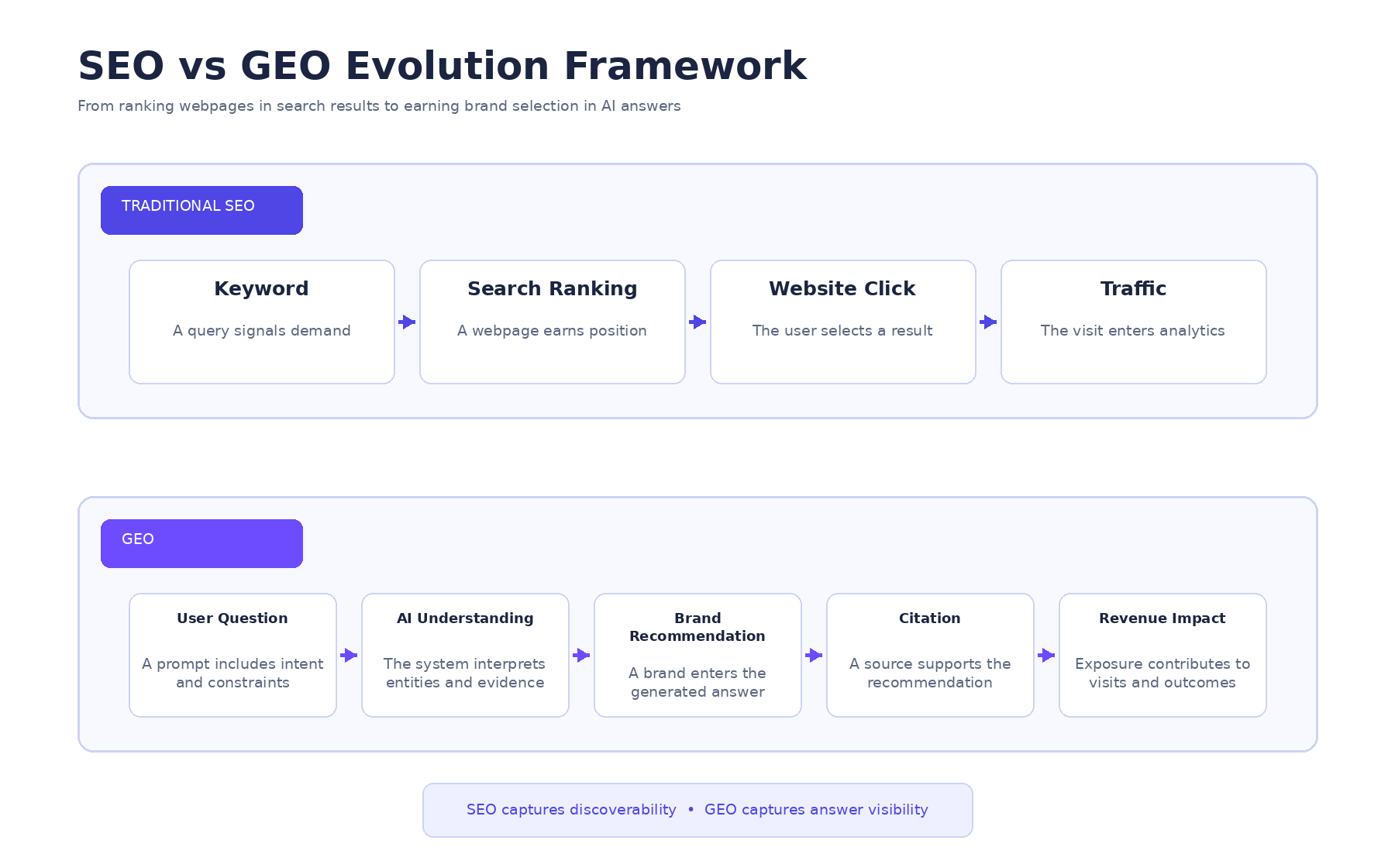
Figure 1: SEO vs GEO Evolution Framework
5. Why Brands Need GEO in 2026
Brands need GEO because a growing share of discovery happens inside systems that summarize and recommend rather than simply rank links. The strategic risk is not only losing traffic. It is losing representation. If a model omits the brand, misclassifies the product, repeats an outdated claim, or relies on a competitor-dominated source set, the brand may never enter the buyer’s consideration set. The website cannot convert a customer who was directed elsewhere before the click.
The zero-click influence gap
AI influence is often difficult to observe. A user may read an answer, remember a brand, search for it later, visit a marketplace, ask a colleague, or purchase through a retail channel. Direct AI referrals capture only the journeys that include a traceable link. GEO programs therefore combine referral analytics with branded-search movement, CRM source data, self-reported discovery, controlled landing pages, marketplace data, and time-based comparisons. The result should distinguish direct, assisted, and inferred impact instead of attributing every conversion to a mention.
Competitive visibility is prompt-specific
A brand can lead in general awareness and lose in high-intent recommendation prompts. It may be visible for “what is” questions but absent from “best for,” “alternatives to,” or “under a specific budget” questions. Competitors may own different attributes: one is associated with performance, another with value, and another with ease of use. GEO exposes these prompt-level positions and helps teams decide where stronger entity signals, content, product evidence, or external corroboration can change the answer.
AI answers compress the consideration set
A search results page can display many options, while a generated answer may recommend only a few. That compression increases the value of inclusion and the cost of omission. It also raises the standard for content. Generic thought leadership may create awareness but provide little evidence for a recommendation. Brands need clear product facts, comparisons, limitations, use cases, policies, research, and proof that answer engines can retrieve and reconcile. The goal is not maximal content volume; it is sufficient high-quality evidence for the decisions that matter.
New metrics reveal different failure modes
A low organic ranking suggests a page-level discoverability problem. A low AI mention rate can indicate weak category association, missing prompt coverage, insufficient corroboration, inaccessible evidence, or competitive source dominance. A high mention rate with low citation probability may mean the brand is known but its owned sources are not useful. A high recommendation rate with poor claim accuracy creates reputation risk. Separating these metrics helps marketing, SEO, content, communications, product, and analytics teams solve the correct problem.
Metrics Brands Should Monitor in AI Search
| Metric | Definition | Diagnostic Question | Business Relevance |
|---|---|---|---|
| Brand mention rate | Share of eligible answers that mention the brand | Does the brand enter the answer? | Measures basic AI inclusion |
| Share of AI voice | Brand mentions relative to tracked competitors | Who owns attention in the category? | Shows competitive visibility |
| Recommendation rank | Observed order within recommendations | How prominent is the brand? | Distinguishes presence from priority |
| Citation probability | Share of eligible answers citing the brand or its sources | Is the evidence being selected? | Indicates source usefulness |
| Claim accuracy | Correct and current claims divided by audited claims | Is the brand represented correctly? | Manages trust and reputation risk |
| Prompt coverage | Visibility across priority intent clusters | Where is the brand absent? | Guides optimization resources |
| AI-driven outcomes | Visits, leads, orders, and assisted revenue tied to AI touchpoints | Does visibility contribute to growth? | Connects answer visibility to value |
6. How GEO and SEO Work Together
The strongest strategy uses SEO as the discoverability foundation and GEO as the answer-visibility layer. Technical SEO makes content crawlable and stable. Information architecture organizes entities and topics. High-quality pages answer demand. Digital PR, links, and reputation expand authority. GEO builds on those assets by measuring actual AI answers, mapping prompt clusters, improving entity clarity, identifying citation gaps, and connecting exposure to downstream outcomes.
One evidence base, two visibility surfaces
A well-designed product comparison can rank for commercial searches and support an AI answer. Original research can earn backlinks, media coverage, citations, and model retrieval. Detailed implementation documentation can satisfy long-tail search demand and help an AI system evaluate product fit. Consistent organization and product data can reduce ambiguity across search engines, answer engines, marketplaces, and knowledge systems. The same asset should be useful to a person first, machine-readable second, and measurable across both surfaces.
A coordinated operating cycle
Teams can coordinate SEO and GEO through a shared cycle. First, identify priority categories, products, markets, and customer decisions. Second, combine keyword research with prompt intelligence. Third, audit technical accessibility, entity consistency, page quality, search rankings, AI mentions, citations, and competitors. Fourth, create or improve evidence for the highest-value gaps. Fifth, distribute that evidence through credible channels. Finally, measure rankings, traffic, AI visibility, referrals, conversions, and assisted outcomes. Each cycle should retain evidence so changes can be audited rather than inferred from a single score.
Different teams, shared accountability
SEO managers should not be expected to solve every GEO problem alone. Product marketing owns positioning and comparisons. Product teams own specifications and roadmap truth. Communications develops independent visibility. Customer teams contribute real questions and proof. Engineering supports accessibility and structured data. Analytics connects exposure to behavior and revenue. GEO provides the measurement framework that allows these teams to see how their work changes AI-generated representation. GeoEye’s role is to make that chain observable: prompt, answer, mention, rank, citation, competitor, visit, and outcome.
| Strategic takeaway: SEO helps a brand become discoverable on the web. GEO helps that brand become understandable, citable, and recommendable inside AI-generated decisions. |
|---|
Frequently Asked Questions
Is GEO replacing SEO?
No. GEO is not replacing SEO because AI search still depends heavily on discoverable, accessible, and authoritative information from the web and other structured sources. SEO remains essential for technical health, webpage visibility, organic traffic, and demand capture. GEO adds a new optimization and measurement layer for generated answers. It evaluates whether AI systems recognize a brand, retrieve useful evidence, cite sources, describe the brand accurately, and recommend it for relevant prompts. The disciplines share assets but measure different surfaces. Brands should maintain SEO foundations while adding prompt intelligence, entity consistency, citation analysis, competitive answer tracking, and AI attribution. The practical shift is from an SEO-only program to a combined search and answer visibility program.
What is the difference between SEO and GEO?
SEO primarily optimizes webpages for visibility in search engine results. GEO optimizes brand representation inside AI-generated answers, citations, comparisons, and recommendations. SEO commonly measures keyword rankings, impressions, clicks, backlinks, organic sessions, and search-attributed conversions. GEO measures mention rate, share of AI voice, recommendation rank, citation probability, claim accuracy, prompt coverage, and AI-driven outcomes. SEO’s unit of analysis is often the query-to-URL relationship; GEO examines the prompt-to-answer-to-brand relationship. The two disciplines overlap through technical accessibility, useful content, entity clarity, authority, and external references. The difference is not that one uses good content and the other does not. It is the surface being optimized and the evidence used to evaluate success.
Why do AI models need citations?
Citations help users inspect the sources behind an AI-generated claim and can make an answer more transparent and verifiable. They are especially useful for current facts, comparisons, research, product specifications, and high-stakes decisions. Different AI systems retrieve and display sources differently, and some answers may not show citations even when external information influenced the response. For brands, citation analysis reveals which sources are being selected, what claims they support, and whether owned or third-party evidence is useful. A citation is not automatically an endorsement or a recommendation. GEO therefore measures citation probability alongside mention, recommendation position, claim accuracy, and downstream outcomes. The goal is credible support, not citations for their own sake.
Can a brand rank well in Google but remain invisible in AI search?
Yes. A webpage can rank well for a keyword while the brand remains absent from AI-generated recommendations. The ranking page may answer a narrow query but provide limited evidence for the user’s broader constraints. The brand entity may be ambiguous, product information may be inconsistent, or independent sources may favor competitors. AI systems may also retrieve different documents, interpret the request differently, or produce a smaller consideration set than a search results page. The reverse is possible too: a well-known brand may appear in AI answers because third-party sources describe it, even when its own site has modest organic visibility. This is why brands need both URL-level SEO measurement and prompt-level GEO measurement.
How should brands start measuring GEO?
Start with a representative, versioned set of prompts tied to real customer decisions. Include category education, use cases, comparisons, alternatives, and purchase-intent questions. Test the prompts across priority models, markets, and languages, recording the complete answer, brand mentions, competitor presence, recommendation order, citations, and claim accuracy. Establish a baseline before changing content. Then connect the prompt data with technical readiness, entity information, source gaps, AI referral sessions, website events, qualified leads, orders, and revenue where available. Repeat tests on a consistent schedule because answers vary. Avoid relying on one screenshot or one overall score; segment results by prompt cluster, product, model, and market.
Key Takeaways
SEO improves how webpages are discovered and ranked in search results, while GEO improves how brands are understood, cited, and recommended in AI-generated answers.
GEO focuses on improving how AI systems understand, recommend, and cite brands.
AI search changes the user journey from query-to-click into question-to-answer-to-recommendation.
A brand can rank well in traditional search and still be absent from an AI-generated recommendation.
GEO visibility should be measured with brand mention rate, share of AI voice, recommendation rank, citation probability, claim accuracy, and prompt coverage.
Entity clarity and consistent evidence help AI systems identify a brand, evaluate its relevance, and support accurate claims.
SEO and GEO work together because crawlable, authoritative, useful web content can support both search rankings and AI retrieval.
AI attribution should distinguish direct referrals, assisted influence, and inferred impact when connecting AI visibility to leads, orders, and revenue.