



Introduction
Brand discovery is moving from a page of ranked links to a generated response that can compress research, comparison, and recommendation into one interaction. A buyer no longer needs to open ten tabs to ask which products fit a specific use case, which vendors meet a compliance requirement, or which options offer the best value for a given budget. ChatGPT, Perplexity, Gemini, and other AI interfaces can synthesize a shortlist, explain trade-offs, cite supporting sources, and answer follow-up questions within the same conversation.
That experience changes what visibility means. In a search engine results page, visibility is often approximated by a URL’s position, impressions, click-through rate, and organic sessions. In an AI-generated answer, the brand can be present without a clickable link, cited without being recommended, recommended without being cited, or described inaccurately even when its own website ranks well. A buyer may remember the recommendation and visit later through branded search or direct navigation. Conventional analytics sees only the later visit, not the earlier influence.
The result is a blind spot for marketing leaders. A brand may be gaining organic traffic while losing inclusion in AI shortlists. Another may receive little AI referral traffic yet shape demand because it is consistently named as a category leader. A third may be highly visible for awareness prompts but absent from high-intent comparisons. None of these patterns can be diagnosed with a rank tracker alone. AI visibility tracking adds the missing answer-layer data: which questions trigger the brand, what role it plays in the response, which competitors surround it, what sources support the answer, and what commercial behavior follows.
This guide presents a defensible operating method rather than a one-off prompt check. It treats each observation as a relationship among a prompt, platform, answer, brand, citation, and outcome. That structure matters because generated outputs are probabilistic and platform behavior changes. A measurement program must be repeatable enough to reveal a trend, detailed enough to explain it, and commercially grounded enough to guide investment. For foundational context on the optimization discipline behind this measurement, GeoEye’s related guide, “What Is GEO (Generative Engine Optimization)?”, explains how brands improve entity clarity, evidence, citations, and recommendation visibility.
1. Why AI Visibility Tracking Matters
SEO reporting was designed for a journey in which a user sees a result, clicks a page, and completes an action that can be recorded in web analytics. That journey still exists, but AI search introduces a decision layer before the visit. The system may summarize a category, remove unsuitable options, compare features, or state that one brand is the best fit for a particular constraint. By the time a person arrives at a website, much of the consideration process may already have happened inside the answer.
This creates three strategic risks. The first is invisible exclusion. If a brand does not appear for commercially important questions, it may never enter the buyer’s consideration set. The second is misrepresentation. An answer can repeat outdated pricing, an old product name, an inaccurate feature limitation, or an unhelpful category label. The third is unmeasured influence. A brand can benefit from AI exposure even when the user does not click a citation immediately, which means referral traffic alone understates the channel’s contribution.
Tracking makes these risks actionable. Prompt-level data shows where visibility is strong or weak. Citation data identifies which sources are shaping the answer. Competitor data reveals who is occupying the category narrative and in what context. Accuracy audits expose claims that need correction. Business-impact data helps leadership distinguish interesting exposure from valuable demand. Together, these signals tell a team whether it needs better product evidence, clearer entity information, stronger third-party corroboration, improved technical accessibility, or a more relevant content strategy.
The management value is prioritization. A company with hundreds of potential questions cannot optimize everything at once. It can, however, identify high-value prompt clusters where competitors are consistently recommended, where the brand has a credible right to win, and where source gaps can be addressed. This turns AI search from an abstract trend into an operating portfolio. Marketing, SEO, communications, product marketing, analytics, and sales can share the same baseline and evaluate changes against the same customer decisions.
| Measurement principle: A single AI answer is an observation, not a ranking. Visibility becomes meaningful only when the same method is repeated across representative prompts, platforms, markets, and time. |
|---|
2. What Does Brand Visibility Mean in AI Search?
Presence is the simplest layer: did the answer name the brand? It is necessary but not sufficient. A brand mentioned as an unsuitable option is not receiving the same value as one recommended for the user’s use case. Prominence adds position and emphasis. A brand listed first, named in the opening synthesis, or selected as the best fit has greater decision influence than a brand buried at the end of a long list. Recommendation context captures why the system included the brand, for whom, and under which constraints.
Accuracy is a separate dimension. Teams should audit factual claims about product capabilities, pricing, availability, integrations, company identity, policies, and market positioning. An answer can produce strong mention metrics while spreading incorrect information. That is why claim accuracy and freshness should sit beside share of voice in any executive view. A visible brand with unreliable representation has a reputation problem, not a visibility win.
Evidence completes the picture. Some answers provide citations or related source links; others do not. When sources are visible, a brand should record the cited domain, exact page, source type, publication date where available, and claim supported. The cited source may be the brand’s own site, a review platform, a publication, a retailer, a forum, a database, or a competitor. Citation tracking reveals the information environment used to construct the answer and often explains why a competitor appears.
Because the answer surface is conversational, visibility should be measured across the decision journey. Discovery prompts ask what solutions exist. Category prompts ask how a problem should be solved. Comparison prompts evaluate alternatives. Validation prompts examine proof, security, reviews, or implementation. Transactional prompts ask what to buy or which provider to choose. A brand can dominate one stage and disappear from another, so a portfolio-level metric should preserve the prompt cluster underneath it.
| Measurement lens | Traditional SEO | AI visibility tracking |
|---|---|---|
| Primary object | Webpage for a query | Brand within an answer to a prompt |
| Visibility | Ranking and impressions | Mention, prominence, recommendation position |
| Engagement | CTR and organic sessions | Citation clicks, AI referrals, later branded visits |
| Authority | Backlinks and domain/page signals | Cited evidence, source diversity, entity consistency |
| Competition | URLs above or below the page | Brands included, excluded, compared, or recommended |
| Business impact | Organic conversions and revenue | Direct, assisted, and inferred AI contribution |
Traditional metrics remain part of the system. Organic rankings help explain whether a brand’s evidence is discoverable, and web analytics captures visits after a click. The mistake is treating those metrics as a complete proxy for answer visibility. GeoEye’s guide to AI Visibility Tracking expands this distinction into a continuous monitoring model: observe the answer, inspect the evidence, compare the market, and then measure the outcome.
3. How ChatGPT, Perplexity, and Gemini Evaluate Brands
No platform publishes a complete formula for deciding which brands appear, and there is no universal “AI ranking factor” that works across every model and mode. The most defensible approach is to measure observable behavior rather than claim access to proprietary algorithms. In broad terms, an AI system interprets the user’s question, identifies entities and constraints, draws on model knowledge and—when available—retrieved sources, weighs the available evidence, and generates a response. Relevance, clarity, corroboration, freshness, accessibility, and source quality can all affect what evidence is usable, but their relative influence varies.
ChatGPT: conversational context plus optional web retrieval
ChatGPT can answer from model knowledge and can use web search for current or web-dependent questions. When search is used, the response may include inline citations and a Sources panel with links. From a measurement perspective, teams should record whether search was active, whether sources were displayed, the conversation context, and the exact model or product mode shown in the interface. Follow-up questions can change the answer because earlier turns refine the user’s constraints. A clean benchmark should therefore test both first-turn prompts and explicitly defined conversational journeys.
Perplexity: web-grounded answers with visible citations
Perplexity describes itself as an AI-powered search engine that searches the web and returns conversational answers backed by citations and links to original sources. That citation-forward interface makes source capture especially important. Teams should not reduce the test to whether the brand’s own domain was cited; third-party sources may be responsible for the mention or recommendation. Record the source order, domains, pages, claim relationships, and whether different search modes alter the source set.
Gemini: variable source presentation across experiences
Gemini Apps may provide links to sources and related content, and research-oriented experiences can use Google Search as a source. The exact presentation can vary by product feature, account, region, and query. A brand audit should therefore log the mode and the availability of source links rather than assume that every answer is grounded or cited in the same way. For questions connected to products, places, shopping, or current information, the surrounding Google ecosystem may also shape the user experience, so the captured evidence should include visible panels and links—not just the generated prose.
What to infer—and what not to infer
Across all three platforms, repeated patterns are more useful than isolated outputs. If a competitor appears in 70 percent of eligible tests across multiple prompts and weeks, that is a meaningful visibility signal. If it appears once in a single run, the result may reflect normal response variation. Likewise, a citation does not prove a permanent endorsement, and the absence of a citation does not prove that no external information influenced the answer. Treat model output as observable evidence, retain the raw response, and label interpretation separately.
References
4. AI Visibility Measurement Framework
A useful framework separates six metrics that answer different management questions. Combining them into one composite score can be convenient for reporting, but the underlying measures should remain visible. Otherwise, a team cannot tell whether a change came from broader prompt coverage, stronger recommendation position, more citations, or better commercial performance.
| Metric | Definition | Calculation / capture | Decision supported |
|---|---|---|---|
| AI Mention Rate | How often the brand appears in eligible answers | Responses mentioning brand ÷ eligible responses | Identify inclusion and prompt-coverage gaps |
| Share of AI Voice | Brand presence relative to tracked competitors | Brand appearances ÷ all tracked brand appearances | Measure competitive attention within a prompt set |
| Recommendation Position | Prominence within ordered suggestions | Average observed position; report missing responses separately | Distinguish being named from being preferred |
| Citation Sources | Evidence linked to the answer or brand claim | Domains, URLs, source types, supported claims, source recurrence | Find influential sources and evidence gaps |
| AI Referral Traffic | Visits arriving from identifiable AI surfaces | Sessions, engaged visits, events, conversions by referrer | Measure direct post-answer behavior |
| AI Revenue Contribution | Commercial value associated with AI exposure | Direct revenue plus separately labeled assisted/inferred value | Allocate investment without overstating causality |
AI Mention Rate and prompt eligibility
AI Mention Rate should use a clear denominator. A brand should not be penalized for prompts where it is genuinely irrelevant, unavailable in the market, or outside the requested price or category. Define eligibility before testing, not after seeing the answer. Calculate the rate by platform, prompt cluster, market, language, and period. A weighted version can give more importance to high-intent or high-value prompts, but the weighting method should be documented.
Share of AI Voice and competitor occupancy
Share of AI Voice compares the brand with a named competitor set. Count appearances consistently: decide whether repeated mentions in one answer count once or multiple times, and whether a recommendation carries more weight than a neutral mention. The simplest method counts each brand once per response. A more advanced model can assign weights for first position, explicit recommendation, citation, or negative context. Report both the raw counts and the weighted score so leadership can understand the result.
Recommendation Position and answer role
Average position is useful only when an answer presents an ordered list or clear sequence. Do not invent a numeric rank when the response is unstructured. Instead, classify the brand’s role: primary recommendation, shortlisted option, neutral example, comparison target, caution, or absent. If a score penalizes absence, state the assigned value. Otherwise, a high average position among a small number of appearances can disguise weak overall coverage.
Citation Sources and evidence influence
Citation analysis should go beyond counting links. Capture whether the cited page supports the brand mention, a category fact, a comparison claim, or a recommendation rationale. Track first-party versus third-party sources, source diversity, domain recurrence, page freshness, and competitor ownership. This creates a source opportunity map. If the same independent review, database, or research page repeatedly supports competitor inclusion, the team has identified an evidence channel—not a guarantee of citation, but a useful strategic signal.
AI Referral Traffic and revenue contribution
Referral traffic is the most observable downstream metric, but referrer data can be incomplete and interface behavior changes. Configure analytics to preserve known AI referrers, landing pages, events, campaign parameters where available, and conversion paths. Then add non-click evidence: self-reported “How did you hear about us?” responses, CRM notes, branded-search lift, direct-traffic patterns, and controlled landing-page experiments. Report revenue in three buckets—direct, assisted, and inferred—to prevent a directional signal from being presented as deterministic attribution. GeoEye’s companion article on AI Attribution provides the deeper measurement model.
5. Step-by-Step Process to Track AI Visibility
The tracking pipeline is a closed loop. Prompt research defines the market questions. Controlled testing creates comparable observations. Mention and citation analysis explain brand presence. Competitive benchmarking provides context. Attribution connects exposure to outcomes. The final step feeds the next prompt and evidence priorities, so the program improves over time rather than producing a static dashboard.
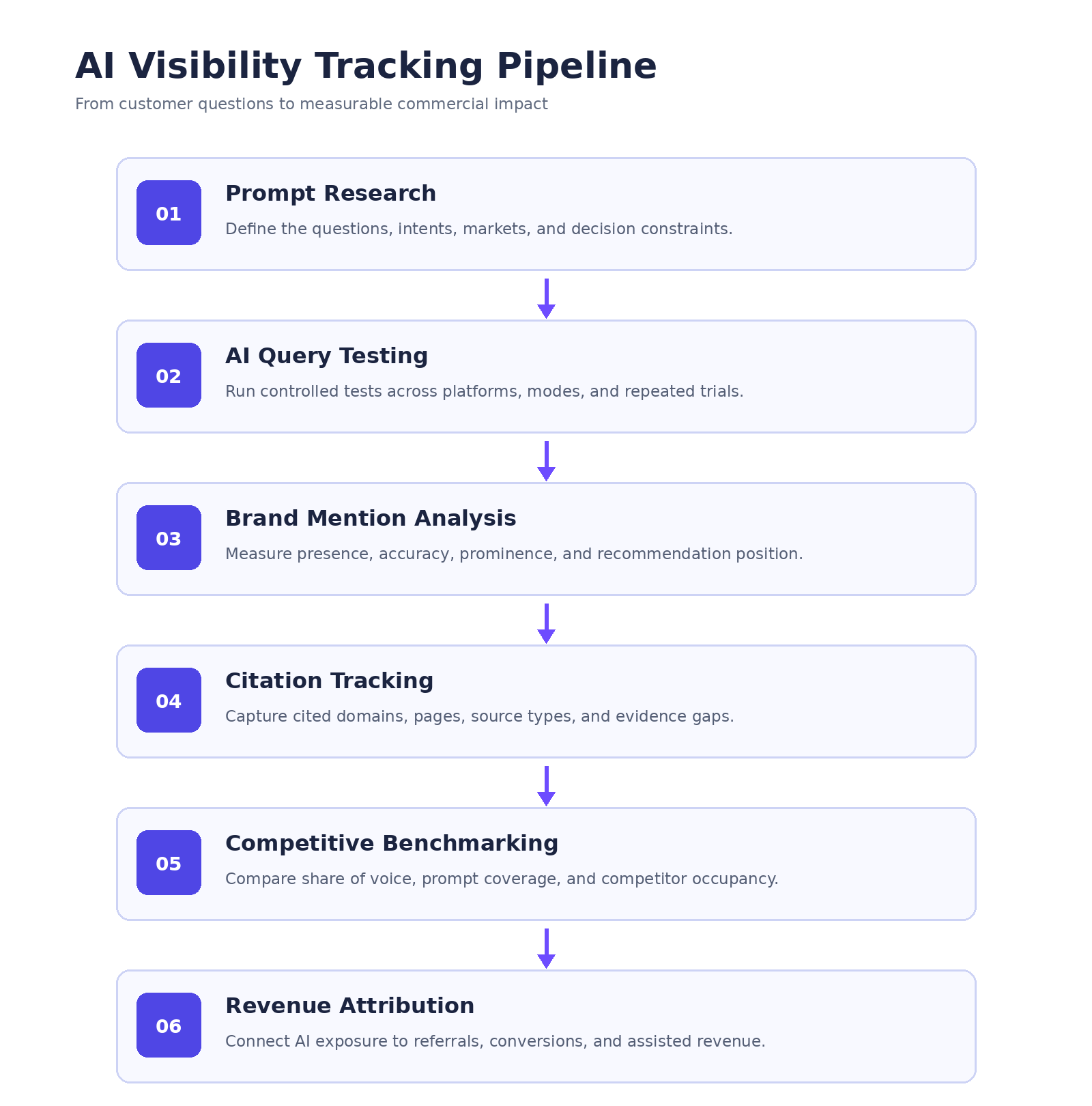
Figure 1: AI Visibility Tracking Pipeline
Step 1: Define Customer Prompts
Start with questions that represent real decisions, not a list of keywords converted into sentences. Gather language from customer interviews, sales calls, support tickets, search queries, community discussions, product reviews, procurement requirements, and competitor comparisons. Organize prompts by journey stage and constraint: problem discovery, category education, use case, feature, comparison, alternative, risk, proof, pricing, and purchase. Include unbranded prompts because those reveal whether the brand can earn discovery beyond existing awareness.
Create a prompt register with a stable identifier, exact wording, intent cluster, product, market, language, persona, buying stage, commercial priority, and eligibility rules. Keep a fixed benchmark set for trend measurement and a smaller exploratory set for emerging questions. Variants are useful, but they should be labeled rather than silently replacing the baseline. “Best CRM for a 20-person agency” and “Which CRM should a small agency choose?” may produce different answers even though their intent is similar.
Step 2: Run AI Search Tests
Test each prompt under controlled conditions. Record platform, model or visible mode, search or research status, account type if relevant, market, language, device context, date, time, and whether the prompt started a new conversation. Use fresh sessions for independent first-turn tests; use scripted follow-ups only when the customer journey itself is conversational. Repeat the test enough times to estimate variability. For an initial benchmark, three to five trials per priority prompt and platform provide more information than one screenshot, though the required sample depends on the decision and reporting cadence.
Preserve the full answer, source links, visible panels, and structured observations. Automation can improve scale, but only if it respects platform terms, product access, rate limits, and privacy requirements. Human review remains necessary for nuanced judgments such as recommendation context, claim accuracy, negative framing, and whether a citation actually supports the statement. Platform interfaces change, so the measurement schema should be versioned along with the prompts.
Step 3: Measure Brand Mentions
Normalize brand and product names before counting. Include common abbreviations and former names only when they unambiguously refer to the same entity. Then classify each response: mentioned or absent; primary recommendation or secondary option; cited or uncited; accurate, partially accurate, or inaccurate; positive, neutral, or negative. Record recommendation position only when an order is explicit. This prevents a simplistic mention count from rewarding a brand that appears in a warning or correcting a misconception.
Calculate AI Mention Rate by platform and prompt cluster, then inspect the underlying responses. A declining rate may reflect competitor gains, prompt-set changes, market availability, or normal variation. Pair the metric with claim accuracy and answer role. GeoEye recommends retaining a response-level audit trail so every dashboard value can be traced back to the exact prompt, answer, date, and source evidence.
Step 4: Analyze Competitor Presence
Define a competitor universe that includes direct competitors, substitutes, marketplaces, and emerging brands. AI answers may create a consideration set that differs from the one used in internal sales decks. Measure competitor mention rate, share of voice, recommendation role, prompt coverage, and citation sources using the same rules applied to the focal brand. Unexpected brands are often valuable: they reveal how the system interprets the category and which alternative solutions buyers may encounter.
Build a prompt-by-brand matrix to show where each competitor is present. Then add a source layer: which domains and pages support those appearances? The objective is not to copy a competitor’s content. It is to understand the evidence patterns behind category visibility. A competitor may win because it has clearer product specifications, more independent reviews, a stronger comparison footprint, better regional availability data, or original research that answers the question directly.
Step 5: Track Business Impact
Configure analytics to identify referral sessions from AI platforms where referrer information is available. Track landing pages, engagement, product views, demo requests, qualified leads, add-to-cart events, orders, and revenue. Preserve first-touch, last-touch, and assisted-touch views rather than choosing a single attribution rule too early. In the CRM, add self-reported discovery and allow sales teams to record AI-assisted research when a prospect mentions it.
For non-click influence, use triangulation. Compare changes in high-priority prompt visibility with branded search, direct visits, lead-source responses, and conversion patterns over the same period. Controlled landing pages, offer codes, geographic tests, and customer surveys can strengthen the inference. Report direct AI revenue separately from assisted and inferred contribution. This distinction makes the result credible: direct means an identifiable AI referral precedes conversion; assisted means AI is one recorded touchpoint among several; inferred means aggregate evidence suggests influence without user-level proof.
Operating Cadence and Quality Controls
A practical program uses three cadences. Priority commercial prompts can be tested weekly to detect meaningful changes. The broader benchmark can run monthly to reveal trends. A quarterly review can update the prompt universe, competitor set, markets, and attribution assumptions based on product changes and customer research. The benchmark set should not be rewritten every month; otherwise the team cannot distinguish market movement from measurement drift.
Quality control begins with reproducibility. Use stable prompt IDs, documented eligibility rules, a consistent entity dictionary, explicit platform metadata, and retained response evidence. Sample human audits should check automated classifications for false mentions, ambiguous product names, unsupported citations, and invented recommendation ranks. When a platform introduces a new mode or changes source presentation, create a new test segment rather than merging incompatible observations.
Executive reporting should answer four questions: Where are we visible? How are we represented? Which sources and competitors shape the answer? What business outcome follows? A useful dashboard pairs trend lines with response examples and diagnostic detail. It should also state sample size and uncertainty. A ten-point change based on five responses is not equivalent to the same change across five hundred responses.
Finally, measurement should trigger specific action. Low mention rate for a high-value prompt may lead to clearer category positioning or new evidence. Strong mentions with weak citations may prompt a source strategy. High visibility with inaccurate claims requires entity and information correction. Good referral traffic with weak conversion points to the landing experience, not the model. The dashboard is valuable only when it shortens the path from observation to intervention.
Frequently Asked Questions
How can I check if ChatGPT recommends my brand?
Create a controlled set of unbranded prompts that real customers would use, then run each prompt in a fresh ChatGPT conversation and record whether your brand appears, its recommendation role, position, claims, and cited sources. Note whether web search was used, the date, market, language, and visible model or mode. Repeat the tests because one response is not a stable ranking. Include discovery, comparison, use-case, proof, and purchase prompts rather than asking only “Do you recommend [brand]?”—a branded question tests recognition, not competitive discovery. Compare your results with the same observations for relevant competitors. The output should be an AI Mention Rate and recommendation-context report, supported by saved responses, not a collection of favorable screenshots.
How do AI visibility tools work?
AI visibility tools run or capture a defined set of prompts across supported AI platforms, parse the generated answers, identify brand and competitor mentions, extract visible citations, classify recommendation position or answer role, and report changes over time. More advanced tools connect prompt results to content, source, referral, conversion, and revenue data. The quality of the output depends on the methodology: stable prompts, sufficient repetition, clear entity matching, platform metadata, evidence retention, and human review for ambiguous cases. A tool should disclose how it handles response variability, missing ranks, negative mentions, source attribution, and market or language differences. Automation increases coverage, but it does not eliminate the need for measurement design or judgment.
What is a good AI Mention Rate?
There is no universal benchmark because the denominator depends on category relevance, prompt difficulty, brand maturity, market, platform, and the mix of buying stages. A 20 percent rate across unbranded, high-intent prompts can be more valuable than an 80 percent rate built mostly from branded questions. Establish a baseline using eligible prompts, segment the rate by intent and platform, and compare it with named competitors. Then set targets where the brand has a credible fit and commercial opportunity. Report sample size and repeated-trial variability. The goal is not maximum mention frequency everywhere; it is reliable, accurate presence in the customer decisions where the brand should reasonably compete.
How often should brands track AI visibility?
High-priority commercial prompts can be monitored weekly, while a broader portfolio is often more practical monthly. Quarterly reviews should refresh customer language, competitors, products, markets, and measurement assumptions without erasing the stable benchmark needed for trends. Frequency should reflect the speed of the category and the decision being made. News, travel, retail availability, and fast-changing software categories may require more frequent checks than stable industrial products. Every run should record platform, mode, location, language, date, and prompt version. Testing more often is not automatically better if the method changes or the sample is too small to distinguish a real movement from normal answer variability.
Can Google Analytics identify traffic from ChatGPT, Perplexity, and Gemini?
Web analytics can identify many visits that arrive with a recognizable referrer, and teams can group known AI domains into a reporting channel. The coverage is not complete: users may copy a URL, open a new tab, use an app that does not pass referral information, search for the brand later, or return directly. Track landing pages, engagement, conversion events, revenue, and assisted paths for identifiable sessions, but do not treat referral traffic as the full measure of AI influence. Add CRM source fields, self-reported discovery, branded-demand analysis, and controlled experiments. Keep direct, assisted, and inferred contribution separate so the report remains transparent.
Why do citations matter for AI visibility?
Citations give users a path to verify a claim and visit the supporting source. For brands, they also reveal which pages and domains are supplying usable evidence for an answer. A citation can support a category fact, a product claim, or the recommendation rationale, so the relationship should be reviewed rather than counted blindly. Citations are not guaranteed endorsements, and a highly visible brand may be mentioned without a link. Still, recurring citation patterns can identify influential sources, content gaps, outdated information, and opportunities for original evidence. The strongest citation strategy is not keyword repetition; it is publishing accessible, specific, current, and verifiable information that genuinely helps answer the target question.
Key Takeaways
AI visibility measures a brand’s presence, prominence, accuracy, citations, and recommendation role inside generated answers—not only traffic after a click.
Traditional ranking, traffic, and CTR metrics remain useful, but they cannot show whether a brand entered an AI-generated consideration set.
AI Mention Rate should be calculated across predefined, eligible customer prompts and segmented by platform, intent, market, language, and time.
Share of AI Voice compares brand presence with competitors, while Recommendation Position distinguishes being named from being preferred.
Citation tracking should capture the exact source and the claim it supports, not merely count the number of links in an answer.
Reliable tracking requires repeated tests, preserved responses, stable prompt IDs, platform metadata, and explicit treatment of uncertainty.
AI referral traffic measures direct visits, while AI revenue contribution should separate direct, assisted, and inferred influence.
The most useful AI visibility program connects prompt research, query testing, mention analysis, citation intelligence, competitive benchmarking, and attribution in one continuous loop.