



Introduction
In traditional search, a brand competes for a visible position on a results page. In AI search, the system may retrieve several sources, reconcile their claims, and generate one synthesized answer. Some sources appear as clickable citations. Others influence the response without receiving a visible link. A brand may be mentioned because a review site describes it, cited through its own documentation, recommended without a citation, or excluded even when its pages rank for related searches.
This creates a deceptively simple business question: why does an AI answer cite one brand and ignore another? The honest answer is that no universal public formula determines citation selection across ChatGPT, Perplexity, Gemini, Copilot, or other answer engines. Their retrieval systems, models, indexes, freshness, interface designs, and source policies differ. The same platform may also behave differently depending on whether live search, deep research, shopping, local information, or model-only generation is active.
Yet citation behavior is not random in the ordinary sense. Observable patterns emerge when teams test a stable portfolio of customer questions and inspect the evidence used in the answers. Sources are more useful when they are accessible, relevant to the exact task, specific enough to support a claim, current where freshness matters, and credible in context. Brands are easier to cite when their identity and products are consistently described, their claims are supported by primary evidence, and independent sources confirm the same facts.
The strategic shift is from “How do we make AI cite this page?” to “How do we create an evidence environment in which this brand is a reliable answer candidate?” The second question is more durable because it accounts for the full citation ecosystem: first-party content, product data, research, reviews, communities, publications, databases, and the relationships among them. GeoEye’s foundational guide, “What Is GEO (Generative Engine Optimization)?”, describes this as optimizing the answer layer rather than chasing a single page position.
What an AI Citation Actually Represents
A citation is not the same as a search ranking. A search result exposes a list of pages; a generated answer can blend information from multiple documents into a new response and cite only selected parts of that evidence set. The citation may support a factual statement, a product specification, a comparison, a recommendation rationale, or background context. It may point to a brand’s website, an independent review, a retailer, a news publication, a research paper, a public database, or a community discussion.
A visible citation also does not prove that the cited source caused every part of the answer. Some systems retrieve more documents than they display, and a model’s learned knowledge can interact with current retrieval. Conversely, a brand mention without a link does not prove that the brand’s web presence had no influence. Citation analysis should therefore distinguish three events: the brand was mentioned, a source was cited, and the cited source directly supported the brand-related claim. Those events often overlap, but they are not interchangeable.
Platform design matters. OpenAI states that ChatGPT responses using search may include inline citations and a Sources panel. Perplexity describes its answers as web-grounded and linked to original sources. Google notes that Gemini Apps may provide links to sources and related content. These interfaces create different measurement surfaces, so a cross-platform audit must record the mode, response, cited URL, and supported claim rather than compare link counts without context.
Research on generative engines reinforces the need for new visibility measures. The foundational GEO paper observes that generated answers embed citations at different positions, lengths, and styles, making visibility more nuanced than conventional rank. This means a brand should track citation probability, citation prominence, claim support, and source diversity alongside mention rate and recommendation position. GeoEye’s companion guide, “How to Track Your Brand’s Visibility in ChatGPT, Perplexity, and Gemini,” provides the operational measurement process.
References
1. Entity Understanding: Can the System Identify the Brand?
Before an AI system can cite a brand confidently, it must resolve what the brand is. Entity understanding connects a name to a distinct organization, product, category, location, founder, specification, certification, or other attribute. That sounds basic, but many companies create ambiguity through inconsistent naming, overlapping product families, unclear category language, outdated company descriptions, or claims that appear only in images and cannot be easily parsed.
Brand identity
A strong entity footprint consistently answers: What is the official brand name? What organization owns it? Which markets does it serve? What is the canonical website? How is it different from similarly named entities? Stable names, company information, About pages, contact details, author profiles, policies, and structured data can reduce ambiguity when they accurately match the visible content. The objective is not to flood the web with the brand name; it is to provide a coherent identity that can be reconciled across sources.
Products and categories
Products should be connected to explicit categories, use cases, audiences, specifications, and limitations. A page that describes a product as “the future of intelligent performance” gives a retrieval system little factual material. A page that states what the product is, who it is for, which problem it solves, which systems it integrates with, what evidence supports its performance, and when the information was updated provides a stronger candidate record. Category consistency also matters: if the website, marketplaces, review sites, and press coverage use conflicting labels, the brand may be retrieved for the wrong questions or omitted from the right ones.
Relationships
Entities become more meaningful through relationships. A software brand may be linked to integrations, certifications, industries, customers, partners, and security standards. A consumer product may be linked to materials, retailers, compatible devices, use cases, and geographic availability. Clear relationships help the system determine fit. They also create paths for corroboration: an integration partner can verify compatibility, a certification body can verify status, and a retailer can verify availability. Relationships stated only by the brand are useful; relationships confirmed by the other entity are stronger.
Consider a fictional inventory platform called NorthstarOps. Its homepage calls the product “operations intelligence,” while directories classify it as warehouse software and customers describe it as demand planning. If the product pages never connect those terms, an AI answer may not confidently include NorthstarOps in a question about inventory forecasting for multi-location retailers. Clarifying the primary category, related categories, target customer, integrations, and proof makes the brand easier to retrieve and compare. Entity clarity does not guarantee citation, but ambiguity creates an avoidable failure before relevance and authority are even evaluated.
2. Content Relevance: Does the Evidence Answer the Question?
Entity clarity establishes who the brand is; content relevance determines whether the available evidence helps answer the current question. AI search is highly contextual. A brand may be relevant to “best project management software” yet irrelevant to “best project management software for a 10-person architecture studio that needs client approvals and EU data residency.” The second prompt introduces audience, workflow, and compliance constraints. Generic category content may not provide enough evidence to justify inclusion.
Topic coverage
Topic coverage is not the number of articles published. It is the completeness with which a brand addresses the concepts and decisions surrounding its category. Useful coverage includes definitions, product facts, implementation requirements, comparisons, methodologies, limitations, pricing logic, compatibility, policies, and proof. A source becomes more citeable when it supplies a fact or explanation that is difficult to replace with generic prose. Original data, transparent methodology, precise documentation, and clearly scoped comparisons can all create information gain.
Semantic matching
Semantic matching concerns meaning rather than exact keyword repetition. The system may connect “customer data platform,” “unified customer profiles,” and “first-party audience activation” when the context supports the relationship. Brands should use the language customers, experts, and product teams actually use, while defining specialized terms directly. Natural synonyms, related entities, specifications, and use cases make the content robust to different prompt phrasings. Repeating one target phrase throughout a page can reduce readability without adding evidence.
User intent
The same topic can contain different intents. An informational prompt may need a neutral definition. A comparison prompt needs explicit criteria and trade-offs. A recommendation prompt needs fit, constraints, and evidence. A troubleshooting prompt needs a reproducible procedure. A current-facts prompt needs freshness and visible dates. Content should be designed for the job the answer must perform. A polished brand story may build trust with people but remain a weak citation candidate for a technical question if it contains no extractable facts.
Relevance also operates at the passage level. A long page can cover the topic broadly while hiding the useful answer inside several screens of unrelated narrative. Descriptive headings, direct definitions, concise claim-to-evidence relationships, tables for genuine comparisons, and clear update dates reduce the work required to locate the relevant passage. Structure should serve comprehension, not attempt to manipulate a model. The underlying information must still be accurate and valuable.
| Citation principle: The strongest citation candidate is not necessarily the page that says the most. It is often the source that answers the exact question with the clearest verifiable evidence. |
|---|
3. Authority Signals: Why Should the Source Be Trusted?
Relevance answers “Does this source address the question?” Authority answers “Is this source credible enough to support the claim?” Authority is contextual. A government regulator may be authoritative for legal requirements, a manufacturer for its own technical specifications, an independent laboratory for test results, a recognized analyst for market data, and an experienced community for real-world usage patterns. No single domain-level score captures all of these relationships.
Industry recognition and expertise
Clear authorship, relevant credentials, transparent editorial standards, disclosed methodology, and a history of useful contributions can help establish expertise. For brands, authority may also come from certifications, standards participation, patents, research collaborations, awards with credible criteria, or documented customer outcomes. Unsupported badges and broad claims such as “industry-leading” add little unless the source explains who recognized the brand, when, and on what basis.
External references
Independent references show that the brand exists beyond its own marketing. Publications, analyst coverage, partner directories, association listings, research citations, public datasets, and customer case studies can corroborate identity and claims. The quality and relevance of the reference matter more than raw volume. One detailed, verifiable industry source may provide more useful evidence than hundreds of low-quality directory entries. External references should also agree on core facts; widespread inconsistency can increase uncertainty rather than trust.
Reviews and community discussions
Reviews and communities can supply information that official pages rarely contain: product reliability, implementation friction, customer service, fit for edge cases, and comparative experience. They are especially relevant when the user asks for opinions, trade-offs, or real-world use. However, community evidence is noisy. Platforms may contain promotional posts, outdated experiences, incomplete context, or coordinated manipulation. Brands should participate transparently and improve the underlying customer experience rather than manufacture discussions. Authentic specificity is more useful than generic praise.
Authority can also be claim-specific. A brand’s own documentation is the primary source for a current feature list, but it is not independent proof that the product is the “most reliable.” An accredited laboratory may be better evidence for measured performance, while verified customer data may support an implementation claim. Citation strategy should match each important claim to the source type best positioned to verify it. This is the beginning of an evidence architecture rather than a backlink campaign.
4. Citation Ecosystem: How Multiple Sources Reinforce Trust
A citation ecosystem is the network of first-party and third-party sources that describe the same entity, claims, and relationships from different positions. AI search engines can retrieve from multiple parts of this network. When credible sources independently confirm the same core facts, the system has more ways to resolve ambiguity and support an answer. When sources conflict, are inaccessible, or merely repeat the same press release, the appearance of volume may not translate into meaningful corroboration.
First-party sources establish the record
The brand website should provide the canonical version of company information, product data, policies, methodologies, and updates. Product pages define the offering; documentation explains how it works; research pages disclose evidence; About and contact pages clarify identity; author and editorial pages establish accountability. Technical accessibility matters because evidence hidden behind scripts, blocked resources, broken canonicalization, or image-only layouts may be difficult to retrieve. For a practical technical foundation, the GeoEye article “GEO vs SEO in 2026” explains how crawlability and search performance support—but do not complete—answer-layer visibility.
Independent sources validate the record
External sources can confirm that the brand’s claims are recognized beyond its own domain. A partner can validate an integration. A customer can document an outcome. A testing organization can validate performance. A marketplace can confirm availability. A respected publication can provide category context. A community can reveal lived experience. These sources are not interchangeable; each has a different evidentiary role. The healthiest ecosystem contains source diversity and clear provenance rather than a cluster of copied descriptions.
Corroboration reduces single-source dependence
Suppose a fictional air purifier brand claims that one model is suitable for a 500-square-foot room. If only the product page states the claim, the system has one primary source. If an independent test explains its methodology, a retailer carries matching specifications, and customer documentation uses the same model number and coverage, the claim becomes easier to verify. If those sources disagree—400, 500, and 700 square feet—the system faces uncertainty and may choose a competing product with clearer evidence.
Corroboration is not the same as repetition. Ten syndicated copies of one announcement may trace back to the same origin and provide little independent confirmation. Strong ecosystems preserve provenance: who produced the evidence, how they know, when it was updated, and what limitations apply. For brands, this means coordinating product, content, communications, partnerships, customer success, and data teams around accurate claims. Citation building is a cross-functional information-quality program, not simply outreach for links.
5. The AI Citation Decision Framework
The framework below summarizes the conditions that increase citation probability. It should be read as a diagnostic sequence, not a disclosed algorithm. A failure at an early layer can prevent later strengths from being used. A brand with strong recognition but irrelevant content may not be retrieved. A relevant page with unsupported claims may be excluded from a high-stakes answer. Independent validation can strengthen confidence, but it cannot repair a fundamentally ambiguous entity.
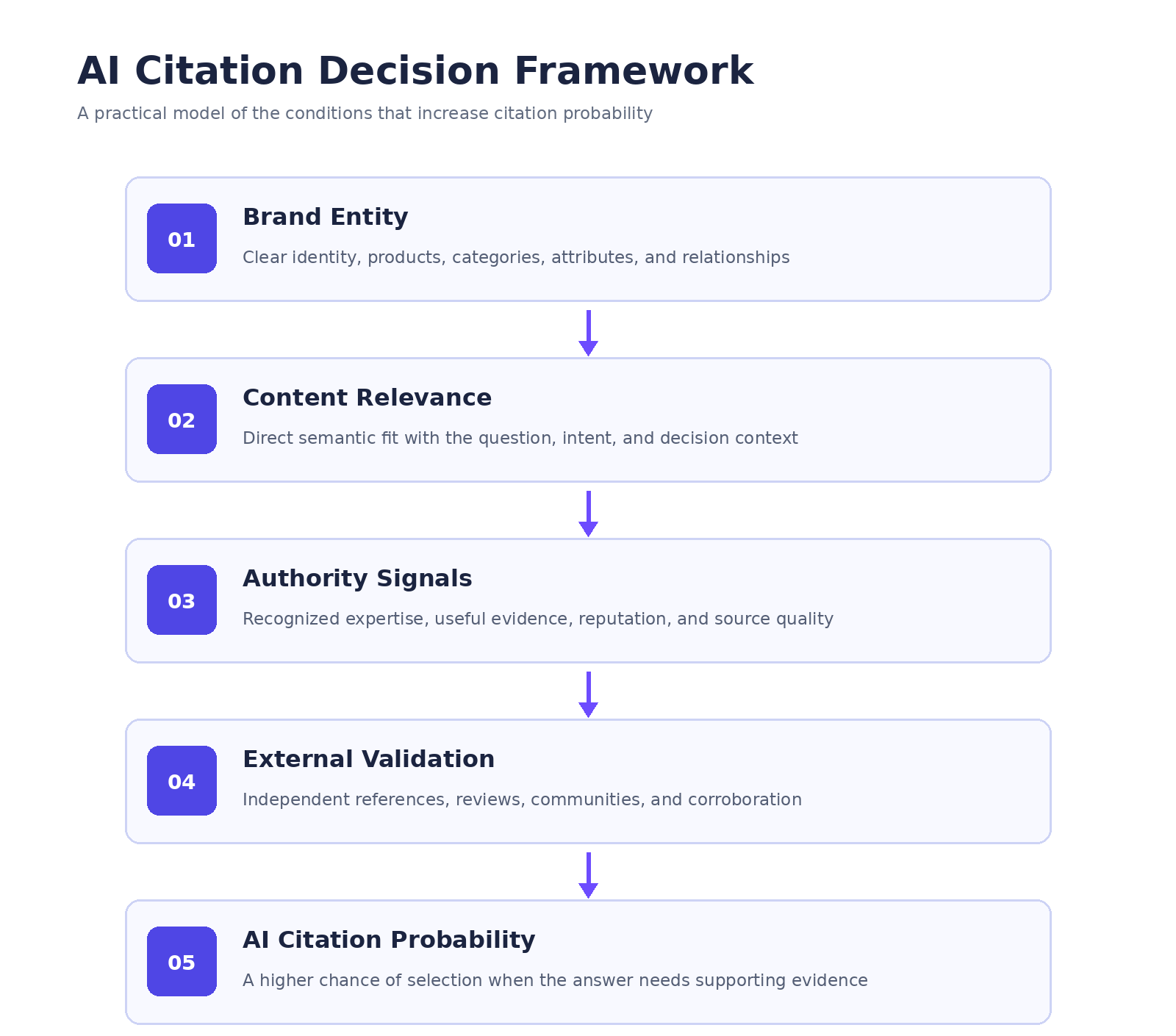
Figure 1: AI Citation Decision Framework
Brand Entity
The system must distinguish the brand and connect it to the correct products, categories, attributes, and relationships. Diagnostic questions include: Are names consistent? Is the category explicit? Can the product be differentiated from similarly named items? Are important relationships confirmed by both sides? Entity problems often appear as missing brands, incorrect descriptions, or confusion between the company and product.
Content Relevance
The available passage must answer the user’s actual question. Diagnostic questions include: Does the source address the intent and constraints? Is the relevant fact easy to locate? Does the page provide information gain? Is it current enough for the query? Relevance problems often appear when a brand is known but omitted from specific use-case or comparison prompts.
Authority Signals
The source and author must be credible for the claim being made. Diagnostic questions include: Is the methodology transparent? Is the author accountable? Does the source have recognized expertise? Is the claim supported by primary evidence? Authority problems often appear when generic marketing claims compete with precise documentation or trusted third-party research.
External Validation
Independent sources should confirm important facts or provide complementary evidence. Diagnostic questions include: Which publications, partners, customers, databases, reviewers, or communities verify the claim? Are they independent? Do they agree on the current facts? Validation problems often appear when the brand’s story exists only on its own website.
AI Citation Probability
When the previous layers align, the source becomes a stronger candidate for retrieval and citation. The result remains probabilistic because platforms use different systems and available sources change. Brands should therefore track citation probability across a stable prompt set rather than promise guaranteed inclusion. Improvement is visible as a repeated increase in cited answers, supported claims, source diversity, and high-value prompt coverage.
High Citation Probability vs. Low Citation Probability
The comparison below translates the framework into observable source characteristics. These are diagnostic patterns, not absolute rules. A high-quality page can still be excluded, and a weak page can occasionally appear. The purpose is to identify controllable conditions that make evidence easier to select and defend.
| Dimension | Higher citation probability | Lower citation probability |
|---|---|---|
| Entity identity | Consistent names, canonical facts, clear ownership and relationships | Ambiguous names, conflicting descriptions, missing company or product context |
| Query relevance | Directly answers the intent, constraints, and comparison criteria | Generic category prose with weak connection to the specific question |
| Evidence | Specific claims supported by data, documentation, or transparent methodology | Unsupported superlatives, vague benefits, or untraceable numbers |
| Source authority | Accountable author or organization with claim-relevant expertise | Anonymous, low-quality, copied, or contextually unqualified source |
| Freshness | Visible update date and current facts where time matters | Outdated pricing, specifications, availability, or policies |
| External validation | Independent sources corroborate important claims and relationships | Claims appear only on the brand’s own domain or copied syndication |
| Accessibility | Indexable, readable content with descriptive structure and stable URLs | Blocked, script-dependent, image-only, duplicated, or poorly canonicalized content |
| Citation fit | Clear passage can support a specific statement in the answer | Useful facts are buried, mixed with unrelated copy, or impossible to verify |
How Brands Can Increase Citation Probability
Citation optimization should start with evidence gaps, not content volume. Select a portfolio of commercially relevant prompts and record which brands are mentioned, which sources are cited, what claims those sources support, and where the focal brand is absent or misrepresented. Segment the findings by user intent, platform, market, language, and time. A repeated gap is more actionable than a single unfavorable answer.
1. Build a canonical entity record
Align the official brand name, company description, product names, categories, target markets, founders, locations, certifications, specifications, and policies across first-party pages. Resolve duplicate or outdated information. Use structured data where it truthfully reflects visible content, but do not treat markup as proof. Confirm important relationships through partner, association, marketplace, or certification sources when appropriate.
2. Map prompts to evidence
For each priority customer question, define the claims an accurate answer would require and the best evidence source for each claim. A security comparison may need certifications and architecture documentation. A product recommendation may need specifications, use-case fit, pricing, availability, and independent reviews. A market trend question may need original data and methodology. This prompt-to-evidence map prevents teams from producing broad articles that add no decision value.
3. Publish answer-ready primary sources
Create or improve product pages, documentation, methodology pages, datasets, comparison resources, implementation guides, policy pages, and case evidence. Lead with direct definitions and factual claims, then explain context, limitations, and proof. Use descriptive headings and real tables where comparison improves understanding. Show authorship and dates. Preserve stable URLs when possible so references do not break after redesigns.
4. Earn independent corroboration
Identify which external source type can credibly validate each important claim. Work with customers on documented outcomes, partners on integration listings, experts on technical review, publications on original research, databases on accurate entity information, and communities through transparent participation. The objective is not artificial consensus. It is to make reliable facts independently discoverable in the places customers and AI systems already use.
5. Measure citations as evidence relationships
Track the cited URL, domain, page type, source ownership, claim supported, prompt, platform, position, and date. Audit whether the citation actually substantiates the generated statement. Measure citation probability as cited eligible answers divided by total eligible answers, then segment it by prompt cluster. Pair the result with brand mention rate, recommendation position, claim accuracy, and business impact. Citation count alone can reward links that have little connection to the brand or decision.
The final step is attribution. A cited source can send referral traffic, but many users will remember the brand and visit later through another route. GeoEye’s article on AI Attribution explains how to separate direct AI referrals from assisted and inferred revenue contribution. This protects the citation program from becoming a visibility exercise with no commercial accountability.
Common Misconceptions About AI Citations
“More backlinks automatically mean more AI citations.”
Links can support discovery and authority, but raw volume does not explain whether a source answers the prompt, supports the claim, or is trusted in context. A strong citation ecosystem includes relevant independent evidence, not simply many placements. Low-quality syndication may repeat a claim without adding verification.
“Schema markup makes a page authoritative.”
Structured data can clarify entities and page content when it matches what users can see. It does not establish that a claim is correct, original, or important. Schema is a machine-readable description, not a substitute for evidence, authorship, or external validation.
“If a brand is not cited, the AI does not know it.”
A brand may be recognized but not relevant to the prompt, may be mentioned without a citation, or may lose selection to a source with clearer evidence. Citation absence has several possible causes. Diagnosis requires comparing entity recognition, retrieval, content fit, source quality, competitor evidence, and platform mode.
“One citation proves the strategy worked.”
Generated answers vary. A single favorable response is an observation, not a stable result. Reliable evaluation requires repeated tests across representative prompts, platforms, markets, languages, and time. The goal is a sustained change in citation probability and supported brand visibility, not a screenshot.
Frequently Asked Questions
Why does ChatGPT cite certain websites?
When ChatGPT uses search, it may attach inline citations or show sources that support parts of the response. The complete selection formula is not publicly disclosed, and behavior varies by question and product mode. In practical testing, a source is more useful when it is accessible, directly relevant, specific enough to support a claim, current where freshness matters, and credible for the topic. Clear passages, primary documentation, transparent methodology, and corroborating sources can improve citation probability. However, no website is guaranteed a citation, and a single response should not be treated as a permanent ranking. Record the exact prompt, search status, answer, source, supported claim, market, and date, then repeat the test across a representative prompt set.
How do AI models choose sources?
AI search experiences can interpret a question, retrieve candidate documents or data, evaluate their usefulness, and synthesize an answer with selected references. The implementation differs across platforms, and not every response uses live retrieval. Observable source-selection factors include semantic relevance to the question, passage-level specificity, accessibility, freshness, credibility, and agreement with other evidence. The system may prefer different source types for different claims: an official page for product specifications, a regulator for legal rules, a study for research findings, or reviews for lived experience. Because proprietary systems do not publish a universal ranking formula, brands should use controlled testing and source analysis rather than assume a fixed checklist.
Does a brand need high Google rankings to be cited by AI?
Strong search visibility can improve discoverability, but it does not guarantee inclusion in a generated answer. AI systems may retrieve and synthesize information differently from a traditional results page, and the cited source may be a third-party publication, marketplace, database, review site, or community rather than the brand’s own page. A highly ranked page can still be a weak citation candidate if it contains generic copy, unclear claims, outdated facts, or little evidence. SEO remains an important foundation because crawlability, site quality, links, and information architecture support retrieval. GEO extends that foundation to entity clarity, answer relevance, citation evidence, recommendation context, and measurement.
Can brands guarantee that ChatGPT, Gemini, or Perplexity will cite them?
No. Brands and GEO providers do not control the final output of proprietary AI systems. Models, retrieval indexes, source availability, query wording, market, product mode, and platform updates can change results. A responsible program improves the conditions associated with citation: coherent entity information, relevant answer-ready content, credible primary evidence, independent corroboration, and technical accessibility. Success should be reported probabilistically across a stable set of eligible prompts—for example, citation probability, source diversity, supported claim accuracy, and high-value prompt coverage. Claims of guaranteed citations or permanent AI rankings should be treated cautiously.
Are reviews and Reddit discussions important for AI citations?
Reviews and community discussions can be important when the user asks about experience, trade-offs, reliability, fit, or comparisons. They provide perspectives that official brand pages may not contain. Their influence varies by platform, query, source accessibility, and evidence quality. Communities are also noisy: posts can be outdated, anecdotal, promotional, or manipulated. Brands should focus on authentic customer experience, transparent participation, accurate product information, and useful expert contributions—not fabricated conversations. In a healthy citation ecosystem, community evidence complements primary documentation, independent testing, reputable publications, and structured product data rather than replacing them.
How should a brand measure AI citation performance?
Build a versioned portfolio of real customer prompts and test it repeatedly across the relevant platforms, modes, markets, and languages. For each answer, capture the brand mention, recommendation role, cited domain and URL, source type, supported claim, source position, claim accuracy, and competitors. Calculate citation probability using eligible answers as the denominator, then segment by intent and platform. Track source diversity and recurrence to identify the evidence channels shaping the category. Pair citation metrics with AI referral traffic, conversions, and separately labeled direct, assisted, or inferred revenue. Preserve the raw response so every dashboard value can be audited.
Key Takeaways
AI citations are visible references selected to support parts of a generated answer; they are not equivalent to traditional search rankings.
A brand is easier to cite when its identity, products, categories, attributes, and relationships are consistent across sources.
Content relevance depends on semantic fit with the user’s intent and constraints, not on repeating a target keyword.
Authority is claim-specific: the most credible source for a product specification may differ from the best source for an independent performance claim.
External references, reviews, communities, partners, publications, and databases can corroborate first-party information when their evidence is independent and relevant.
A citation ecosystem is strongest when sources provide diverse, traceable confirmation rather than copies of the same original claim.
No optimization method can guarantee a citation; performance should be measured as a probability across repeated, representative tests.
A mature citation strategy connects entity clarity, relevant content, authority, external validation, citation tracking, and business attribution.