



Introduction
When an AI answer recommends a brand, the visible citation is often only the tip of a larger information environment. The system may search for current sources, retrieve candidate pages, compare evidence, and synthesize a response that links to selected documents. Depending on the question, those documents can include a manufacturer’s product page, an industry publication, a review platform, a Reddit thread, a standards body, a research paper, a retailer, a government source, or another company in the category.
This makes the question “Which channels do AI models cite?” both important and easy to oversimplify. A list of the most-cited domains from one study can be useful, but it does not become a permanent playbook. ChatGPT, Perplexity, Gemini, Copilot, and other systems use different retrieval stacks and interfaces. Transactional prompts may favor product or marketplace information; experiential prompts may surface communities and editorial content; technical and high-stakes questions may require research, standards, or primary documentation.
Research supports this variability. A 2026 comparative study reported significant differences between generative AI services and Google Search in the source domains and source types they consulted. Another audit of Gemini hotel recommendations found that experiential and transactional prompts produced materially different source mixes. Studies also find low overlap in the domains cited by different generative systems. The practical implication is not that channels are unpredictable, but that source strategy must begin with user intent and evidence roles rather than a single “best platform.”
For brands, the goal is to build a citation ecosystem: a coordinated set of owned and independent sources that identify the brand, explain its products, prove important claims, reflect real-world experience, and contribute original knowledge. GeoEye’s article “How AI Search Engines Decide Which Brands to Cite” explains the selection conditions. This guide focuses on where that evidence should live and how brands should distribute it.
How AI Citation Channels Work
A channel is not a ranking factor by itself. A page on a respected publication can be irrelevant to the prompt, while a precise product documentation page can be the best source for a specification. A Reddit comment may provide the most useful explanation of a real-world edge case, while a peer-reviewed paper may be required for a scientific claim. Source value depends on the relationship among the question, the claim, the evidence, and the source’s authority to provide it.
Citation also has two distinct stages. First, the platform decides whether to search and which sources to select. Second, the generated answer may absorb facts, wording, structure, or evidence from those sources. A page can be cited but contribute little to the final recommendation, or it can supply the decisive claim. Brands should therefore measure both citation selection and citation influence—not simply count links.
Platform documentation confirms that citations are part of modern AI search experiences. OpenAI states that ChatGPT search responses may include inline citations and a Sources panel. Perplexity describes its answers as linked to original sources. Google states that Gemini Apps may show sources and related content. These products do not publish a universal preferred-domain list, and their source presentation changes across modes. Controlled prompt testing remains necessary.
References
1. Official Websites: Entity Ownership
An official website is the brand’s canonical source of truth. It should establish the legal or operating entity, brand name, product names, categories, target markets, locations, policies, specifications, documentation, and current availability. When an AI system needs to verify what a product is, which features it includes, or how the company describes its offering, the official site has a legitimate primary-source role.
What official websites do best
Owned pages are strongest for facts the organization controls: current product details, compatibility, pricing logic, shipping policies, security documentation, implementation requirements, executive information, research methodology, and company announcements. The source should distinguish stable facts from marketing claims. “Integrates with Salesforce and HubSpot” is verifiable. “The world’s most intelligent platform” is not meaningful evidence without a definition and proof.
Why entity ownership matters
Entity ownership gives the system a canonical record to reconcile against other sources. A complete About page clarifies the organization. Product pages connect products to categories, use cases, and specifications. Documentation explains how the product works. Structured data can make visible information easier to parse when it is accurate. Stable URLs, clear authorship, update dates, and accessible HTML improve the usability of that record.
The limits of owned authority
A company is authoritative about its own specifications but not automatically authoritative about comparative superiority. A skincare brand can state its ingredients; an independent laboratory is better positioned to verify a performance test. A software company can document an integration; the integration partner can independently confirm it. The official website owns the claim, but a recommendation often requires evidence beyond self-description.
Consider a fictional industrial sensor company, VectorSense. Its website provides detailed tolerances, certifications, environmental ranges, and installation documentation. Those pages are strong candidates for technical questions. But if the prompt asks which sensor is most reliable in offshore conditions, the website’s claim needs support from independent testing, customer evidence, relevant standards, or credible industry coverage. Owned media establishes the record; the ecosystem validates it.
2. Industry Media: Authority and Category Context
Industry media includes trade publications, specialist newsletters, analyst commentary, professional associations, expert interviews, and established editorial outlets. These sources can place a brand inside a market narrative, compare alternatives, explain why a development matters, and introduce independent expert judgment. Their value is strongest when the publication has real subject expertise, clear editorial responsibility, and content directly relevant to the prompt.
Independent recognition
A third-party publication can confirm that the brand is recognized within a category. This does not mean every press mention is valuable. A copied press release, paid placement without disclosure, or generic founder profile may add little evidence. A detailed product evaluation, market analysis, technical interview, or reported customer implementation can contribute facts and context that the brand cannot independently validate on its own site.
Editorial comparison and interpretation
Recommendation questions frequently require comparative reasoning. Industry media can define evaluation criteria, explain trade-offs, and compare vendors across a common framework. The quality of the comparison matters. Transparent methodology, current product information, disclosed commercial relationships, and evidence links make the source more useful. “Best” lists produced only to capture affiliate traffic can be cited, but citation does not automatically make them trustworthy.
Category language and entity relationships
Specialist media often supplies the terminology used by experts and buyers. It connects brands to category changes, regulations, use cases, and competitors. Those relationships can help AI systems interpret where the brand belongs. For a new or niche company, one authoritative category article may create more semantic clarity than dozens of generic syndication placements.
Earned-media strategy should begin with evidence worth covering. Original data, a credible benchmark, a new technical method, a documented market shift, or a strong customer outcome gives journalists and analysts something substantive to evaluate. Distribution cannot compensate for an empty claim. The brand should also maintain a fact sheet and source package so external descriptions remain accurate.
3. Review Platforms: Trust Signals and Comparative Experience
Review platforms aggregate customer experience around products, software, services, travel, local businesses, and marketplaces. They can expose recurring strengths and weaknesses, satisfaction patterns, implementation difficulty, support quality, durability, value, and fit for specific users. These signals are particularly relevant when an AI prompt asks what customers think, whether a product is reliable, or which option is better for a particular situation.
Structured comparison
Many review platforms organize products by category, rating, feature, company size, use case, or buyer profile. That structure can help answer engines locate comparative evidence. A review page may connect a brand with categories and competitors more explicitly than the brand’s own website. Detailed reviews containing context—such as team size, deployment scenario, product version, or purchase use—are more informative than a rating without explanation.
Trust, volume, and recency
Review value is not a simple average score. A high rating from a small or outdated sample can be less useful than a current body of detailed reviews. Brands should monitor accuracy, respond constructively, and resolve the product or service problems behind repeated criticism. They should not manufacture reviews or pressure customers into misleading statements. Review manipulation can damage both customer trust and the integrity of the citation ecosystem.
Platform dependence
The review channel varies by industry. G2 or Capterra may matter for software; retailer and marketplace reviews can matter for products; TripAdvisor and booking platforms can matter for travel; app stores can matter for mobile software; sector-specific databases may matter for regulated or professional categories. The relevant question is not “Which review site is largest?” but “Where do target customers evaluate this type of decision, and is that source accessible and credible for the prompt?”
Reviews should complement primary facts. A customer can report that onboarding felt fast, while official documentation explains the actual process and requirements. A review can say a device was durable in practice, while a test report provides controlled evidence. When these sources agree, the recommendation has a stronger foundation. When they conflict, the brand has an information or product gap to investigate.
4. Communities: Real-World Discussions and Edge Cases
Communities include Reddit, specialist forums, Q&A sites, professional groups, open discussion boards, and public creator conversations. They reveal the language people use before a polished category vocabulary exists. They also expose edge cases, objections, workarounds, comparisons, and lived experience that official pages and editorial reviews may not capture. This makes communities especially relevant to experiential prompts.
Why community content can influence answers
A question such as “Which carry-on survives cobblestone streets?” or “What CRM works when clients must approve designs?” asks for contextual experience. Community discussions may contain exactly those situations. When publicly accessible and retrievable, such pages can be cited directly or contribute language and considerations that shape the answer. However, source use varies by platform and query. One study may find Reddit prominent in a dataset while another finds product-oriented AI search favoring publisher and review domains.
Does Reddit matter?
Reddit can matter, but it is not a universal GEO shortcut. Public threads can surface candid product comparisons, troubleshooting, and niche expertise. They can also contain anonymous claims, outdated information, affiliate promotion, coordinated marketing, and low-context opinions. AI systems may cite a thread, ignore it, or use other sources for the same question. Brands should evaluate the specific communities their customers trust rather than treating Reddit as a distribution checkbox.
How brands should participate
Useful community participation is transparent and contribution-led. Employees or experts should disclose their relationship to the brand, answer the actual question, cite evidence when relevant, and avoid scripted praise. The goal is to improve the information environment, not simulate customer enthusiasm. In many communities, an honest explanation of limitations is more credible than a promotional answer. Owned accounts also need governance so future readers can identify who made the claim and when.
Community content can also inform the rest of the strategy. Repeated questions should become documentation or FAQ topics. Common objections can shape comparison pages. Real-world edge cases can inspire testing and research. Vocabulary can improve prompt coverage. The channel is both a distribution surface and a customer-intelligence source.
5. Research Content: Knowledge Authority
Research sources include peer-reviewed papers, preprints, standards, government data, public datasets, technical reports, benchmarks, surveys, testing methodologies, and original brand research. They are most valuable when the answer requires evidence beyond opinion: market size, performance, safety, scientific effects, technical capability, or a measurable trend. Research can make a brand citeable because it contributes knowledge rather than only describing a product.
Original evidence and information gain
A source has information gain when it adds facts, data, or analysis that are not easily found elsewhere. Original datasets, experiments, benchmarks, and transparent surveys can supply that value. The methodology must explain sample, scope, definitions, dates, limitations, and conflicts of interest. A chart without accessible data or a statistic without methodology is difficult to verify and easier to misinterpret.
Standards and high-stakes questions
For regulatory, scientific, medical, financial, security, or engineering questions, source quality becomes especially important. Standards bodies, government agencies, recognized institutions, and primary research may have the strongest claim-specific authority. Brand-created educational content can explain these sources, but it should link to and accurately represent them rather than position itself as the original authority.
Research distribution
Publishing a report on the company website is only the first step. The brand should provide a stable landing page, downloadable methodology, machine-readable tables where possible, named authors, update dates, and a clear citation format. It can then brief industry media, partners, customers, expert communities, associations, and researchers who may evaluate or reuse the findings. Independent discussion gives the research a life beyond the original domain.
Research also improves owned and earned content at the same time. Product pages can reference measured evidence. Media can report the findings. Communities can debate the implications. Reviewers can use the methodology in comparisons. A well-designed research asset becomes the central proof object within a citation ecosystem. GeoEye’s guide to AI citation selection explains why transparent evidence and external validation are more durable than keyword repetition.
The AI Citation Source Ecosystem
The diagram below presents the channels as an evidence sequence, but the relationship is not strictly linear. Official facts can feed research; research can earn media; media can trigger community discussion; reviews can reveal questions that improve documentation. AI systems may retrieve from any layer depending on the user’s intent. The strategic objective is consistency with complementary evidence, not identical messaging across every surface.
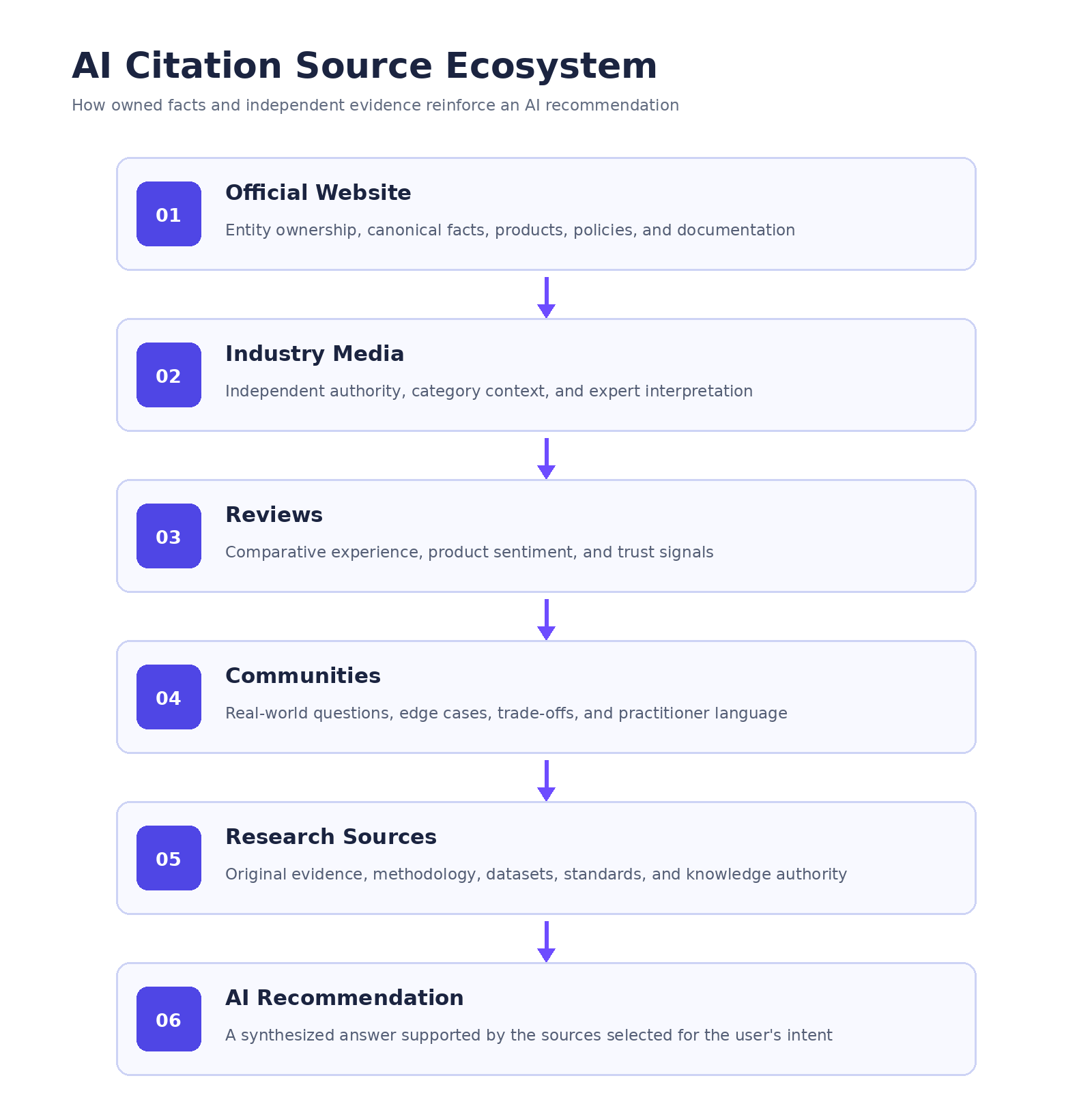
Figure 1: AI Citation Source Ecosystem
Channel Roles at a Glance
| Channel | Primary evidence role | High-value formats | Common weakness |
|---|---|---|---|
| Official website | Entity ownership and canonical facts | Product pages, documentation, policies, methods, datasets | Self-claims without independent proof |
| Industry media | Authority and category context | Reported analysis, interviews, evaluations, market coverage | Thin syndication or commercial bias |
| Review platforms | Comparative experience and trust | Detailed verified reviews, category comparisons, user profiles | Manipulation, stale samples, missing context |
| Communities | Real-world discussion and edge cases | Threads, Q&A, troubleshooting, practitioner comparisons | Anonymity, noise, promotion, outdated claims |
| Research sources | Knowledge authority and original evidence | Studies, benchmarks, standards, datasets, technical reports | Opaque methodology or unsupported statistics |
Why Publishing Only on Your Website Is Insufficient
A brand website is necessary because it owns the canonical entity and product record. It is insufficient because many customer questions require independent judgment. A company can state what its product does, but recommendation prompts often ask whether the product is credible, how it compares, what customers experience, and whether the evidence holds outside the company’s own framing. Those questions naturally draw on external sources.
Website-only publishing also creates a single point of failure. If the site is difficult to crawl, the relevant passage is vague, a page is blocked, or the system selects other sources, the brand has no alternative evidence path. A distributed ecosystem allows a partner, publication, review platform, community, or research repository to confirm the same core fact from another angle. Source diversity is resilience, not just reach.
Another limitation is audience. Customers do not conduct all research on company websites. They compare software on review sites, discuss products in communities, read trade media, watch experts, and consult standards or research. Distribution places evidence within the environments where questions already exist. It can also reveal discrepancies: if external reviewers describe the category differently from the brand, the entity or positioning needs clarification.
External distribution should not mean copying one article to twenty domains. Duplicate syndication provides little independent validation and can blur provenance. Each channel should perform a distinct job. The official site publishes canonical facts. Media interprets the category. Reviews document experience. Communities discuss edge cases. Research assets establish evidence. Together, they give an AI answer multiple sources with different reasons to be trusted.
| Distribution principle: Do not distribute the same claim everywhere. Distribute the evidence needed for different sources to independently explain, test, compare, or validate the claim. |
|---|
Content Distribution Strategy
A citation-oriented distribution strategy coordinates four portfolios: Owned Media, Earned Media, Community Content, and Research Assets. The portfolios should share consistent entity facts while contributing different forms of evidence. Every asset should map to a priority prompt cluster, a customer decision, a source role, and a measurable outcome.
Owned Media
Owned media creates the canonical evidence base. Priority assets include product and service pages, documentation, comparison criteria, implementation guides, security and policy pages, author profiles, FAQs, research landing pages, datasets, and methodology pages. Content should be accessible, current, specific, and clearly structured. Important claims need sources or primary proof. Stable URLs and update processes reduce citation decay.
Earned Media
Earned media creates independent category recognition and validation. Start with stories supported by evidence: original data, credible product developments, technical expertise, customer outcomes, or market changes. Target publications and analysts with the right topical authority rather than maximizing placement volume. Provide fact-checkable materials and disclose commercial relationships. Measure whether coverage appears in relevant AI citations and recommendations, not only referral traffic or media impressions.
Community Content
Community content creates transparent, real-world participation. Identify the forums, subreddits, professional groups, and Q&A sites where customers already ask meaningful questions. Contribute expertise, clarify misconceptions, disclose brand affiliation, and acknowledge limitations. Use recurring questions to improve owned documentation and research. Measure contribution quality and prompt relevance; post volume is a poor proxy for trust.
Research Assets
Research assets create information gain. Design benchmarks, surveys, experiments, public datasets, industry indexes, or technical reports around questions the market cannot answer well. Publish the methodology, sample, definitions, limitations, and update schedule. Offer reusable charts and machine-readable data. Brief media, partners, experts, and communities who can examine the work independently. The strongest research asset can support every other distribution portfolio.
A Six-Step Distribution Process
1. Define the decision prompts
Group real customer questions by category education, use case, comparison, validation, and purchase intent. Prioritize them by commercial value and current visibility.
2. Audit the current source mix
Record which domains, pages, and channel types are cited across repeated tests. Identify which sources support the brand, competitors, or category claims.
3. Map each claim to the right source role
Decide what the official site should establish, what needs independent media or review evidence, what communities can illuminate, and what requires research.
4. Create the primary evidence
Fix entity facts, improve documentation, publish verifiable product information, and produce original assets before seeking distribution.
5. Distribute through complementary channels
Earn coverage, support authentic customer reviews, contribute transparently to communities, and place research where experts can evaluate it.
6. Measure and refresh
Track citation probability, source diversity, claim accuracy, recommendation position, AI referral behavior, and revenue contribution over time.
The final measurement layer matters. A cited page may increase brand visibility without producing a click, while another source may send high-intent traffic. GeoEye’s article “What Is AI Attribution and How to Measure AI-Driven Revenue” explains how Pixel, analytics, and CRM data can connect identifiable AI referral behavior with leads, purchases, and revenue. Distribution should be judged by both answer-layer influence and business impact.
A Practical Example
Consider a fictional carry-on luggage brand, Wayline. Its website provides product dimensions, materials, warranty, compatible airline sizes, and repair policies. Those pages establish canonical facts. Yet the brand rarely appears for prompts about luggage that performs well on cobblestones, survives frequent train travel, or fits strict European airline limits. Competitors dominate through review lists, travel communities, retailer reviews, and packing guides.
Wayline builds a channel-specific evidence plan. It improves the official product pages with wheel construction, measured dimensions, testing methodology, and regional availability. It commissions an independent durability test with a disclosed protocol. Travel media receives the data and evaluates the design. Customers are invited to leave honest reviews after real use. Company experts transparently answer maintenance questions in relevant travel communities without scripting recommendations. A public report summarizes the test and limitations.
Over repeated prompt tests, the brand begins to appear through different evidence paths. Technical questions cite the official specification and test report. Comparison prompts cite editorial evaluations. Experience prompts surface community discussions and detailed reviews. Not every answer cites the same source, and some platforms continue to prefer established competitor pages. The ecosystem improves resilience because the brand is no longer dependent on one owned article.
The commercial layer then shows which sources matter beyond visibility. Editorial citations produce engaged product sessions; a travel community thread generates fewer visits but higher conversion; the research report attracts media and partner links. The team keeps the channels distinct and invests according to evidence quality, prompt coverage, and business impact rather than raw link volume.
Frequently Asked Questions
Does AI cite websites?
Yes. Search-enabled AI systems can cite or link to webpages when they retrieve current or relevant information. The source may be an official company website, publication, review platform, community, research paper, government page, database, marketplace, or other accessible web resource. Not every answer uses live search, and not every retrieved source receives a visible citation. Platform behavior also varies by mode and query. Brands should test representative prompts and record the exact cited URL, source type, supported claim, platform, market, and date. A website is more useful when it is accessible, directly relevant, specific, current where necessary, and credible for the claim.
Does Reddit influence AI answers?
Reddit can influence or appear in AI answers when public threads are accessible and relevant to the user’s question. It is particularly useful for real-world experience, niche comparisons, troubleshooting, and language that may not appear in official content. Its importance is not universal. Different studies and platforms show different source mixes, and transactional questions may favor official, marketplace, review, or publisher sources. Reddit also contains noise, outdated claims, anonymous promotion, and manipulation risk. Brands should contribute transparently to relevant communities, disclose affiliations, answer the actual question, and avoid fabricated discussions. Reddit is one possible evidence channel—not a guaranteed citation tactic.
How can brands increase AI citations?
Brands can increase citation probability by improving the entire evidence system. Start with consistent entity information and accessible first-party pages. Publish direct answers, product facts, documentation, comparisons, and transparent methodology for priority customer prompts. Earn independent validation through relevant media, partners, customers, review platforms, experts, communities, and research distribution. Track which sources support brand mentions and competitor recommendations across repeated tests. Citation probability should be measured by prompt cluster, platform, market, and time. No brand can guarantee a citation because models and retrieval systems are proprietary and variable; the practical objective is to become easier to identify, retrieve, verify, and use as evidence.
Which citation channel is most important for GEO?
There is no universal winner. The most important channel depends on the question and the claim. Official websites are essential for canonical product and company facts. Industry media can supply independent authority and comparisons. Reviews reveal customer experience. Communities expose edge cases and practitioner language. Research and standards provide evidence for technical or high-stakes claims. A brand should map priority prompts to the source type best qualified to answer them. The strongest strategy uses a portfolio: owned facts plus independent corroboration and original knowledge. Measure actual citation patterns in the target category rather than applying a cross-industry channel ranking.
Are backlinks the same as AI citations?
No. A backlink is a link from one webpage to another. An AI citation is a source reference selected within a generated answer. Backlinks can support discoverability, reputation, and traditional SEO, but they do not guarantee that a page will be retrieved or cited for a particular prompt. AI citation selection also depends on relevance, passage-level evidence, freshness, source authority, entity clarity, and the answer’s needs. Likewise, a brand can be cited through a third-party source that does not link prominently to the brand. GEO measurement should inspect the answer, the cited page, the supported claim, and the downstream outcome—not use backlink count as a citation proxy.
How should brands measure a citation ecosystem?
Build a versioned set of customer prompts and run repeated tests across relevant AI platforms, markets, languages, and modes. For each answer, capture brand and competitor mentions, recommendation role, cited URL, source domain, source channel, supported claim, source position, and accuracy. Report citation probability, source diversity, first-party versus third-party share, channel coverage, recurring domains, and prompt gaps. Then connect identifiable AI referrals with product views, CTA clicks, leads, purchases, and revenue. The dashboard should preserve raw response evidence and separate observation from inference. A healthy ecosystem is not the one with the most links; it is the one that provides accurate, complementary evidence across the decisions that matter.
Key Takeaways
AI models can cite official websites, industry media, review platforms, communities, research sources, databases, marketplaces, and other accessible webpages.
There is no universal channel ranking; source selection varies by platform, retrieval mode, user intent, market, freshness, and the evidence available.
Official websites own canonical brand and product facts, but they cannot independently validate every comparative or performance claim.
Industry media adds authority and category context, while reviews contribute comparative experience and trust signals.
Reddit and other communities can influence experiential answers, but their visibility is variable and their evidence requires careful evaluation.
Research assets create knowledge authority by contributing original data, transparent methodology, standards, or measurable evidence.
Publishing only on the brand website creates a single-source dependency; external distribution provides independent corroboration and alternative retrieval paths.
A mature citation ecosystem coordinates owned media, earned media, community content, and research assets, then measures both AI visibility and revenue impact.